
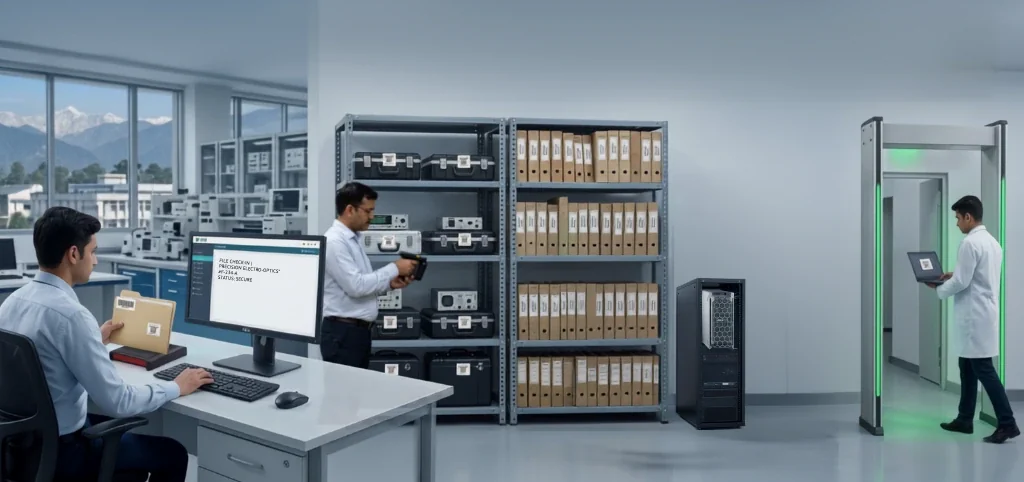
IRDE (Instruments Research and Development Establishment), Dehradun, is a premier defence research laboratory under DRDO, Ministry of Defence, Government of India. Managing thousands of physical files, classified records, and assets across multiple departments had become a serious operational challenge. Files were misplaced, inventory audits stretched for weeks, and there was no real-time visibility into where a document or asset was at any given moment.
POXO designed and deployed FATS, a File, Asset and Tracking System, a unified, RFID-powered platform covering file tracking, record management, and inventory management within a single application. The outcome was faster day-to-day operations, significantly stronger security, and complete real-time visibility across the organization.
About the Client
IRDE is one of India’s leading defence research laboratories, specialising in electro-optic systems, night vision devices, laser rangefinders, and other precision instruments for the Indian Armed Forces. With hundreds of scientists, engineers, and administrative staff working across its Dehradun campus, IRDE handles a large volume of sensitive files, research documents, and physical assets every day. Keeping track of all of this manually had become increasingly difficult and operationally risky.
The Challenge
Before FATS, IRDE relied entirely on manual processes to manage its files, records, and physical assets. This created problems that were slowing down operations and creating security risks.
- Manual File Tracking: Whenever someone needed a file, they had to physically search for it — across shelves, cabinets, and rooms. There was no system to tell anyone where a file was last kept. This caused delays, especially during urgent reviews or when senior officials needed documents at short notice.
- Disorganised Archives: IRDE had accumulated thousands of legacy files over the years. These were not catalogued digitally. Staff often did not know whether a particular file even existed, let alone where it was stored. Retrieval was time-consuming and unreliable.
- Inventory Inaccuracies: Annual inventory verification was done manually, with physical counting followed by cross-referencing Excel sheets. The process was slow, prone to errors, and often left discrepancies unresolved for months.
- Security Gaps: There was no audit trail showing who accessed which file or asset and when. Sensitive records could be moved or removed without leaving any record, posing a significant compliance and security risk for a defence establishment.
- No Centralised Reporting: Management had no dashboards or real-time reports to work from. Decision-making depended on manually compiled data that was often outdated or incomplete.
The Solution: FATS - A Three-in-One RFID Platform
POXO built FATS as a single integrated platform with three modules, each directly addressing one of the core problem areas. Rather than deploying separate systems, everything runs from one application, making it simpler to operate, maintain, and scale.
Module A: RFID-Based File Tracking System
This module addresses the most fundamental problem: not knowing where a file is. Every physical file receives an RFID label, and from that point the system tracks it automatically.
- Role-Based Access: Administrators, clerks, and officers each log in with their own permissions. No user can access files outside their authorised scope, and every action is recorded in an audit trail.
- Automated Data Capture: When a file is picked up or moved, critical details such as file number, department, and cost centre are captured instantly without manual entry.
- Live Location Tracking: RFID tags provide real-time location updates. Staff can search the system and see exactly which room or department holds a file at that moment.
- MIS Dashboards: Management can access custom reports showing file movement trends, pending actions, and active file analysis at any time.
Module B: Record Management System
This module operates like a smart library for government records. Every file — including legacy documents stored in archives – receives an RFID tag and is entered into the system. Issuance and return follow a library-style checkout process.
- Digitisation and Tagging: All legacy paper files and active records were tagged and entered into the digital system for the first time, making the entire archive searchable.
- Library-Style Issuance: Staff use handheld RFID scanners to check files out and return them. The system updates automatically in seconds.
- Secure LAN-Only Access: All data is hosted on IRDE’s internal network. No data leaves the premises, and only authorised on-site users can access the system.
- Automated Alerts: If a file is overdue, not returned, or moved without a proper checkout, the system sends an instant notification to the responsible officer.
Module C: Inventory Management System
IRDE maintains hundreds of assets across departments, including lab equipment, computers, instruments, and furniture. This module ensures every asset is accounted for, correctly allocated, and auditable at any time.
- Migration from Excel: All inventory previously held in disconnected spreadsheets was consolidated into one central, structured platform.
- Fast RFID Audits: Annual inventory counts that previously took weeks now complete in a fraction of the time. Handheld scanners read multiple asset tags simultaneously without needing line of sight.
- Department-wise Allocation: Every asset is linked to a department and a responsible person. Real-time logs record every movement or reassignment.
How It Was Built: Technical Implementation
The FATS was built with security and reliability as the primary considerations. As a defence establishment, IRDE required the entire system to run on an isolated internal network with no internet connectivity.
System Architecture
The web application was built on the .NET Framework using C#, powering all backend APIs, the admin panel, and the main user interface accessed from desktop computers. A companion Android application, developed in Kotlin, runs on the handheld RFID devices used by field staff for scanning, file issuance, and inventory audits. All data is stored in Microsoft SQL Server, providing secure and scalable storage for every transaction, movement record, and user action. APIs connect both the handheld scanners and the fixed RFID gate readers to the backend in real time.
Key Security and Deployment Features
- Isolated LAN Deployment: The entire system is hosted on IRDE’s internal network with no external internet access, ensuring sensitive data never leaves the premises.
- AES-256 Encryption: All stored data is protected with military-grade AES-256 encryption.
- Role-Based Access Control: Every user operates within a defined permission scope. All actions are automatically logged in a tamper-proof audit trail.
- MS-Excel Interoperability: The system supports bulk data import and export via Excel, simplifying the initial data migration and ongoing operations for teams accustomed to spreadsheets.
- Phased Rollout with Training: Deployment was carried out department by department, with dedicated training for administrators and field staff at each stage.
- User Acceptance Testing: Every module was tested with actual IRDE users before go-live to confirm correct operation under real-world conditions.
Hardware Deployed
The following hardware was supplied and installed by POXO as part of the FATS project at IRDE Dehradun:
- RFID Desktop Reader: Installed at the entry and exit points of file rooms and offices. When a tagged file or asset passes near it, the reader identifies it automatically without any manual scanning. Every movement is logged instantly and synced to the system, making it the primary detection point for files leaving or entering secured areas.
- RFID Paper Labels: Thin, lightweight RFID sticker labels applied to each physical file or document. Each label carries a unique ID readable wirelessly from a distance. Designed for decades of use without degradation, every label is customized with the file number, barcode, or QR code serving as the file’s permanent digital identity.
- UHF Asset Tags: RFID tags designed for physical assets such as equipment, instruments, furniture, and computers. These can be fixed to metal, glass, plastic, or wooden surfaces and withstand harsh conditions. Each tag carries a unique ID linked to the asset record, enabling instant identification and tracking during audits.
- UHF Handheld Reader: An Android-based handheld device used by field staff for on-the-spot RFID scanning. Staff use this device to issue or return files, conduct inventory audits, and verify asset locations. Running the FATS mobile app, it communicates with the central server over the internal network and reads hundreds of tags per second — making bulk inventory counts extremely fast.
- RFID Gate Reader: Installed at doorways and room entrances. The fixed RFID reader automatically detects any tagged file or asset passing through without anyone needing to scan manually. If a file moves through a gate without a proper checkout being recorded in the system, an alert is triggered, serving as the primary safeguard against unauthorized movement of sensitive materials.
- Server: A Dell PowerEdge tower server hosts all three FATS modules on IRDE’s internal network. It stores all file records, asset data, user activity logs, and transaction history, and is configured with AES-256 encryption, Secure Boot, and DRDO-compliant access controls.
Results: What Changed After FATS Was Deployed
The impact of FATS was visible almost immediately after go-live. Here is a summary of the outcomes across the key areas:
- Operational Efficiency: File retrieval time dropped by 65%. Staff no longer spend time physically searching for files — a quick system search returns the exact location instantly. Inventory verification that previously took weeks now completes ten times faster, with handheld RFID scanners reading multiple tags simultaneously.
- Real-Time Monitoring: Every file and asset can be located on the system at any time. Management and administrators know where records are, who holds them, and when they were last moved. Automated alerts flag overdue files or unauthorized movements without any manual monitoring effort.
- Security: Unauthorized access incidents dropped by 85%. With role-based access control, complete audit trails, and gate readers logging every movement, no file or asset can be accessed or relocated without a record being created. AES-256 encryption and LAN-only deployment ensure all data stays fully secured within IRDE’s premises.
- Transparency and Accountability: Real-time tracking has eliminated manual audit exercises entirely, saving significant man-hours each year. Every action, from file issuance to asset reassignment, leaves a clear, timestamped record that cannot be altered.
- Scalability: FATS is built on a modular architecture. IRDE can extend coverage to additional departments, add new asset categories, or integrate new capabilities without rebuilding the system.
Conclusion
The FATS project at IRDE Dehradun demonstrates what is possible when the right technology is applied to a real operational problem. Before FATS, IRDE was dealing with missing files, slow audits, security blind spots, and no reporting visibility. Today, every file is tracked live, every asset is accounted for, and management has a clear picture of operations at all times.
The system replaced error-prone manual processes with automated tracking, secured sensitive data through encryption and access controls, and delivered actionable insights through real-time dashboards, all within an isolated, secure network environment appropriate for a defence establishment.
This successful deployment highlights POXO’s expertise in designing and implementing secure RFID-based tracking solutions for high-security environments. As an ISO 9001:2015 certified provider of end-to-end RFID and IoT automation solutions, POXO helps organizations across India improve visibility, security, compliance, and operational efficiency through customised technology solutions tailored to their unique requirements.