
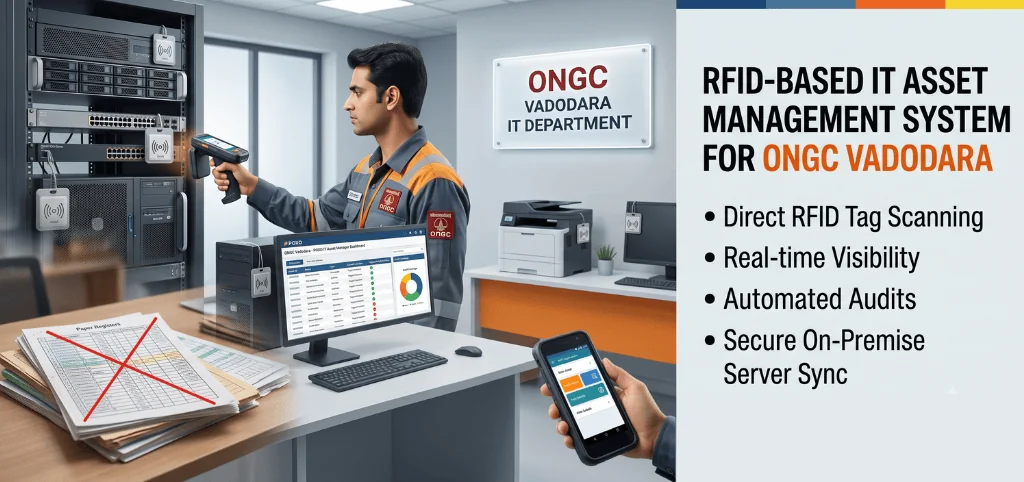
Oil and Natural Gas Corporation (ONGC), Vadodara handles a large number of IT and infrastructure assets spread across several buildings, floors, and rooms — from desktops and printers to networking equipment and other office hardware. Keeping track of them by hand, using paper registers and spreadsheets, made it difficult to know exactly what equipment existed, where it was placed, and whether it was still there during audits.
POXO worked with ONGC Vadodara to deploy an RFID-based IT Asset Management System that replaces the manual process with a simple scan-and-record method — giving the facility accurate, real-time visibility of every asset it owns, with all data held on ONGC’s own on-premise server.
The Challenge
Before the system was introduced, asset verification at ONGC Vadodara depended on manual registers and physical checklists. Every audit meant a team walking room to room, noting asset details by hand and later matching them against old records — slow, error-prone, and with no real-time visibility.
If an asset was moved between rooms without a register update, it showed up as missing at the next audit even though it was very much on site. Locating a specific asset, generating an accurate inventory report, or simply knowing how many assets existed in a particular building took far more time and effort than it should have.
The Solution
POXO designed the system around four simple activities that mirror how an asset is actually handled: tag it, map it, audit it, sync it. Every IT asset carries an RFID tag, and the facility team uses a handheld RFID reader to scan, map, and audit without any paperwork.
- Hardware: The MT93 RFID Handheld Reader serves as the primary scanning device, running POXO’s HHT Application directly on the device. Every IT asset was fitted with a rugged RFID Hard Tag built to stay firmly attached to desktops, printers, and networking hardware long-term — a permanent digital identity the reader picks up instantly.
- Software: The solution runs as a web application hosted on ONGC’s own on-premise server — no external cloud dependency, all asset data inside the organisation’s IT environment. The HHT Application handles identification, mapping, and audits in the field, while the Asset Tracking Application organises everything into searchable records and reports on the web.
How the System Works
Identification
Scan any RFID tag with the handheld reader trigger and instantly view the linked asset’s details — name, serial number, model. Any piece of equipment is identified within seconds.
Mapping
Each asset is linked to its exact physical location — building, floor, and room. Every asset gets a fixed digital address inside the facility that stays current even when the asset is moved and re-mapped.
Audit
The module that proves most useful during verification drives. The team scans the RFID tag at a room’s entrance, and the application automatically detects every tagged asset inside and compares it against what should be there — sorting assets into found, missing, and unexpected. Work that took a team several days with printed checklists is now a short walkthrough completed in minutes, with most of the scope for human error removed.
Sync
All data pushes and pulls to the on-premise server over a simple IP connection, so every identification, mapping update, and audit result recorded in the field reflects on the central system almost immediately.
Implementation and Integration
Rollout began with fitting RFID Hard Tags onto every IT asset across the facility and registering each tag in the Asset Tracking Application. The MT93 readers, loaded with the HHT Application, were configured and handed to the on-ground team with basic training — scanning, mapping, and auditing require no technical background. The handheld application was integrated with the web application over the on-premise server, so every field scan syncs back to central records immediately. That close integration between hardware, handheld software, and the central web application makes the whole process work as one connected system rather than a set of separate tools.
The Impact
- Audits in Minutes: Asset verification drives that once took days now complete in a fraction of the time.
- Locations Always Known: Every asset’s building, floor, and room is recorded and stays updated through re-mapping.
- One Central Record: The facility team has a clear, centralised, searchable record of every IT asset across the campus.
- Full Data Control: Running entirely on ONGC’s own on-premise server, the organisation retains complete control over its asset data at all times.
Conclusion
This project reflects POXO’s continuing work in bringing practical RFID solutions to large government and public-sector facilities, where accurate asset visibility, data security, and ease of use matter as much as the underlying technology. The system deployed at ONGC Vadodara shows how a straightforward scan-based approach can replace years of manual record keeping with a system that is simple for field staff to use and reliable for management to depend on.
Looking to modernise asset tracking at your facility? Explore POXO’s asset management solution or talk to our team.