
A single missing component can stop an entire production line. In automotive, electronics, FMCG, and industrial manufacturing, that component may be low-cost, but the downtime it causes is not.
Traditional kanban systems were designed to improve flow and reduce excess inventory. But many plants still depend on manual cards, operator calls, spreadsheets, or delayed warehouse updates to trigger replenishment. These methods work only when demand is stable, people follow the process perfectly, and material movement is visible at every stage.
Modern manufacturing rarely operates under those conditions.
A Digital Kanban Solution uses RFID, IoT, barcode scanning, smart displays, and ERP integration to automate replenishment signals between production lines and warehouses. The objective is not to replace lean principles. It is to make them faster, more reliable, and measurable in real time.
Key Takeaways
Digital Kanban improves warehouse-production coordination by automating replenishment triggers and exception alerts. RFID, IoT, barcode scanning, and smart displays help reduce line-side shortages while improving replenishment response time. ERP-ready Digital Kanban also creates a scalable foundation for lean manufacturing, traceability, and future automation.
Why Manual Kanban Breaks Down in High-Pressure Production Environments
Manual kanban depends on discipline and timing. A card must be picked, moved, recorded, and acted on without delay. In a controlled environment, this may be sufficient. In a high-mix or fast-moving plant, small gaps quickly become production risks.
Common operational problems include lost kanban cards, delayed material requests, wrong bin identification, inaccurate stock assumptions, and no clear ownership of exceptions. A warehouse team may believe material has already been dispatched, while the line team is still waiting. The ERP may show availability, but physical stock is sitting in the wrong staging zone.
This creates operational friction across the plant. Supervisors spend time chasing updates instead of managing throughput. Warehouse staff respond reactively. Production teams build informal buffer stocks to protect themselves, which weakens lean inventory discipline.
The problem is not kanban as a concept. The problem is that the signal is not digital, real-time, or traceable.
What a Digital Kanban Solution Actually Does
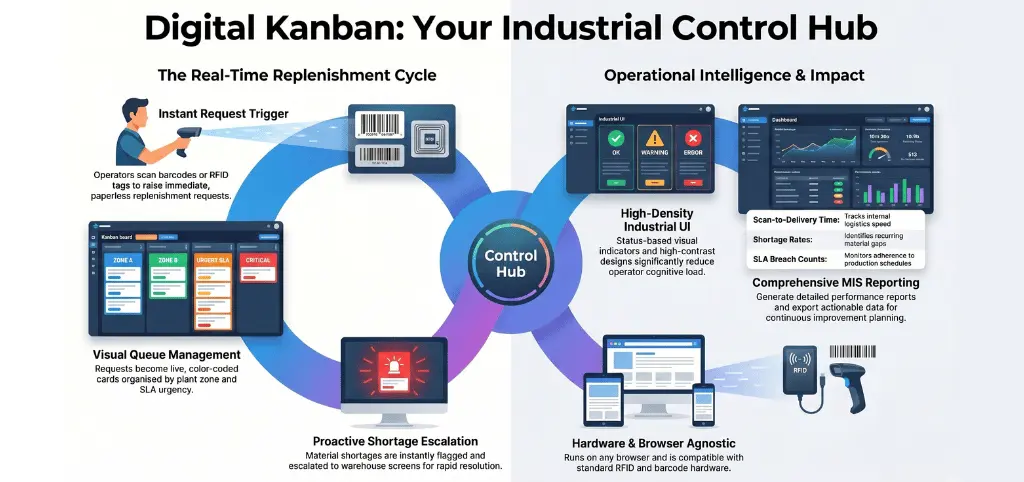
A Digital Kanban Solution converts manual replenishment signals into automated, trackable workflows. It connects line-side consumption, warehouse picking, material movement, and ERP updates through a structured system.
In a POXO Digital Kanban setup, RFID tags, barcode labels, IoT-enabled bins, scanners, smart displays, and integration layers work together to create real-time visibility. When the stock reaches a predefined level, the system can automatically trigger a replenishment request. Warehouse teams receive clear instructions. Production teams see material status. ERP systems such as SAP, ServiceNow, or other enterprise platforms receive structured data for reconciliation and planning.
The value is not only faster communication. It is better control over replenishment behaviour. Instead of asking whether a material request has been received or dispatched, teams can immediately see the current status: consumed, requested, picked, in transit, delivered, or delayed.
Core Components of Digital Kanban
A strong Digital Kanban system usually includes several connected layers:
• RFID-based bin or container identification for automatic material movement tracking
• Barcode scanning for controlled confirmation at pick, dispatch, receipt, or line-side consumption points
• IoT sensors or smart devices to detect bin status, stock level, or material movement
• Smart displays for production and warehouse teams to view live replenishment priorities
• ERP integration for inventory updates, exception workflows, and transaction accuracy
• Dashboards for cycle counts, response delays, shortage risks, and dock-to-line movement visibility
The best results come when these components are designed around the plant’s actual material flow rather than around technology alone.
Operational Scenario: Automotive Assembly Line Replenishment
Consider an automotive component plant supplying sub-assemblies to an OEM. The line uses multiple fast-moving parts stored in line-side bins. In the manual process, operators place empty bins in a collection area and rely on material handlers to identify and replenish them.
The plant experiences recurring micro-stoppages. No single stoppage appears severe, but over time, the lost minutes affect output and overtime costs. Root cause analysis shows that replenishment requests are often delayed during shift changes, and warehouse teams do not always know which bin is most urgent.
With Digital Kanban, each bin is tagged with an RFID tag. When a bin moves to the empty-bin zone, the system captures the event automatically. A replenishment request is displayed on the warehouse screen with part number, quantity, location, and priority. The material handler scans dispatch, and the production-side smart display shows that the item is on the way.
If the material is not dispatched within the defined response time, an exception alert is raised. The supervisor sees a shortage risk before the line stops. This changes the operating model. The team moves from reactive firefighting to exception-based control.
Business Benefits Beyond Faster Replenishment
Faster replenishment response time is usually the first visible benefit. But the deeper ROI comes from better coordination and cleaner operational data.
Digital Kanban reduces dependency on informal communication. Operators no longer need to call, message, or physically escalate every shortage risk. Warehouse teams receive structured tasks instead of incomplete requests. Production heads gain visibility into recurring constraints that were previously hidden inside daily firefighting.
The system can also improve inventory reconciliation. When material movement is captured digitally, discrepancies between ERP stock and physical stock become easier to identify. This supports more reliable cycle counts and reduces avoidable stock adjustments.
For lean manufacturing teams, Digital Kanban provides measurable evidence. Instead of assuming that a two-bin system is working, teams can analyse replenishment response time, frequency of shortages, recurring delay zones, and abnormal consumption patterns.
Where ROI Typically Appears
Digital Kanban creates measurable value across several operational areas. Manufacturers often see reduced production downtime linked to material shortages, lower response delays between warehouse and production lines, improved inventory control without excessive safety stock, and stronger traceability for audit and compliance readiness. It also improves warehouse picking discipline, dispatch accuracy, and ERP transaction reliability.
The financial impact depends on production volume, downtime cost, part criticality, and current process maturity. In high-value production environments, even small reductions in stoppages can justify automation quickly.
The Non-Obvious Shift: Kanban Is Becoming a Control System, Not Just a Replenishment Method
Many manufacturers still view kanban as a visual inventory tool. That view is becoming too narrow.
In digitally mature plants, kanban data is becoming part of the production control layer. It shows how materials behave in motion, where replenishment constraints appear, and which parts create hidden operational risk. This makes the system valuable not only for warehouse teams but also for planning, maintenance, quality, and continuous improvement.
For example, repeated urgent replenishment requests for the same component may indicate poor demand planning, inaccurate BOM consumption, supplier variability, or process leakage. Without a digital signal history, these issues often remain invisible.
The forward-looking advantage is that Digital Kanban creates time-stamped operational evidence. As plants adopt more automation, this evidence can support predictive replenishment, dynamic line feeding, and more accurate WIP tracking.
How to Evaluate Readiness for Digital Kanban
Before implementing a Digital Kanban system, operations leaders should assess process readiness. Automating a weak process without standardising material flow can simply make errors faster.
Start by mapping current replenishment triggers. Identify how material requests are created, who receives them, how response time is measured, and where delays occur. Review whether part numbers, bin locations, minimum levels, and replenishment quantities are standardised.
Next, evaluate system readiness. Determine whether the ERP can support real-time inventory updates, whether warehouse locations are structured, and whether barcode or RFID labelling maturity already exists within the plant. Operations teams should also assess the frequency of emergency material requests and the accuracy of line-side inventory records.
POXO supports this transition by connecting RFID, IoT, barcode scanning, smart displays, and ERP-ready integration into one scalable Digital Kanban framework. The focus is on centralising material movement data, improving traceability, and enabling automation without disrupting production discipline.
Forward-Looking Insight: Real-Time Visibility Will Become a Manufacturing Standard
Over the next several years, manufacturers will increasingly evaluate operational performance not only through throughput or output metrics, but through visibility maturity. The ability to track inventory movement, replenishment response, and shortage risks in real time will directly influence production stability and operational resilience.
Digital Kanban adoption will grow not simply because automation is attractive, but because real-time replenishment visibility will become a baseline expectation in modern manufacturing operations.
Conclusion
Digital Kanban should not be treated as a technology upgrade alone. It is a practical step toward real-time warehouse-production coordination and more resilient lean manufacturing.
For manufacturers dealing with recurring shortages, response delays, emergency line feeding, or inventory reconciliation problems, Digital Kanban provides a more structured and measurable replenishment model. By integrating RFID, IoT, barcode scanning, smart displays, and ERP connectivity, manufacturers can reduce avoidable production risk while building a scalable foundation for future automation and operational visibility.
Frequently Asked Questions (FAQs)
**1. What is a Digital Kanban Solution?
** A Digital Kanban Solution automates material replenishment signals between production lines and warehouses using technologies such as RFID, barcode scanning, IoT devices, smart displays, and ERP integration.
**2. How does Digital Kanban reduce production downtime?
** Digital Kanban reduces downtime by triggering replenishment requests earlier, improving response visibility, and alerting teams when material movement is delayed or at risk.
**3. Is RFID required for Digital Kanban?
** RFID is highly useful for automatic identification and movement tracking, but barcode scanning, IoT sensors, and smart displays can also be part of the system, depending on the process and budget.
**4. Can Digital Kanban integrate with SAP or ServiceNow?
** Yes. A scalable Digital Kanban system can be designed to integrate with SAP, ServiceNow, and other enterprise platforms for inventory updates, workflow alerts, and operational reporting.
**5. Which industries benefit most from Digital Kanban?
** Automotive, electronics, FMCG, industrial manufacturing, and other high-volume or high-mix production environments benefit when material shortages directly affect throughput.