
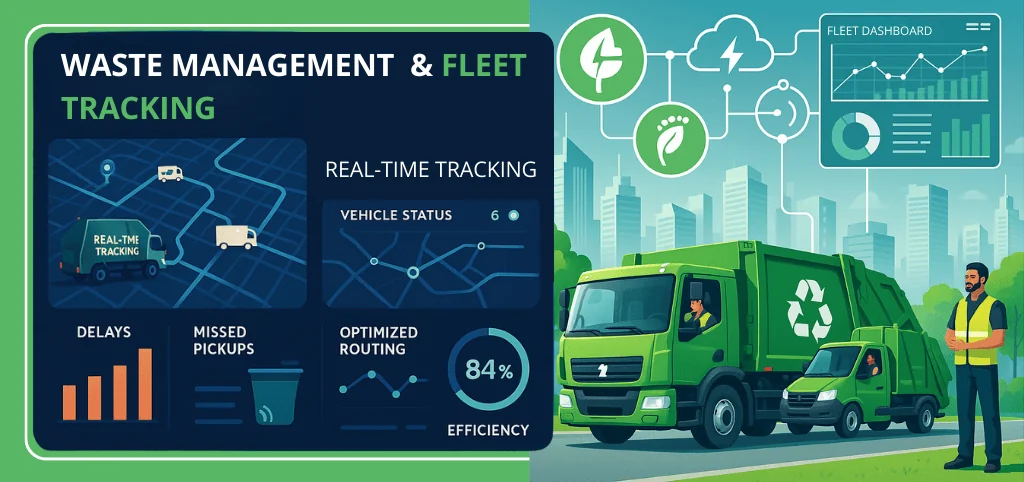
Waste collection is one of the most visible public services in any city. When it works well, residents barely notice it. When it does not, complaints rise quickly, and trust drops just as fast.
At first glance, waste collection seems straightforward. Trucks follow planned routes. Bins are emptied. Crews return to base. In reality, daily operations are affected by traffic congestion, road closures, vehicle breakdowns, and staffing challenges.
This is where waste management & fleet tracking become essential. It provides the visibility needed to manage operations effectively and keep services running smoothly, even when conditions change.
Why Traditional Waste Operations Struggle
Many waste collection routes were designed years ago. Since then, cities have expanded, traffic patterns have shifted, and service demands have increased. However, routes often remain unchanged.
Without real-time visibility, missed pickups are usually discovered only after residents complain. By then, crews are already off schedule, overtime costs increase, and service quality suffers.
Decisions based on assumptions rather than data slowly lead to higher costs, inefficient routing, and reduced reliability.
What Fleet Tracking Improves
GPS-based fleet tracking brings transparency to daily waste operations. Managers can see where vehicles are located, which streets have been completed, and where delays are occurring.
Solutions like POXO help turn waste fleets into connected systems. Vehicles appear on live maps, routes can be adjusted during the day, and missed areas are identified early before they become service issues.
This level of visibility allows teams to move from reactive problem-solving to proactive operational control.
Real Results from Cities
Cities using fleet tracking report consistent and measurable improvements. Collection delays typically decrease by 15 to 25 percent. Fuel and labour costs often drop by up to 20 percent. In many cases, unnecessary driving is reduced by nearly 30 percent.
In one municipality, tracking data revealed that multiple trucks were covering overlapping streets each morning. Once routes were reviewed and redesigned, one full daily collection round was eliminated. The result was immediate savings in fuel, reduced overtime, and more predictable service delivery.
Smarter Routes Make Daily Operations Easier
Route optimisation is not about creating ideal routes on paper. It is about planning based on real- world conditions.
Fleet tracking allows managers to understand actual travel times, identify recurring delays, and pinpoint high-cost routes. This information supports better scheduling and more efficient use of vehicles.
Smarter routing leads to fewer trucks on the road, lower fuel consumption, and more reliable collection times. Residents may not see the changes behind the scenes, but they experience the benefits through consistent service.
Supporting Sustainability Goals
Waste collection fleets are a major source of transport emissions for cities. The main challenge has always been accurate measurement.
Fleet tracking provides clear data on idle time, fuel use, and driving behaviour. This makes it possible to reduce emissions through better routing, lower idle time, and safer driving practices.
With reliable data, sustainability teams can produce accurate ESG reports and demonstrate measurable progress toward environmental targets.
Benefits for Drivers and Crews
Fleet tracking also supports frontline teams. Clear routes reduce confusion and stress. Real-time updates prevent last-minute changes that disrupt the workday.
When issues occur, data explains what happened without placing unfair blame on drivers. This improves morale, supports safer driving, and helps with long-term workforce retention.
Conclusion: The Key Takeaway
At its core, waste management & fleet tracking is about visibility. When city leaders and operators can see what is happening on the road, they can make informed decisions, control costs, and improve service reliability.
The key takeaway is simple. Waste operations cannot be effectively managed without real time insight. Fleet tracking replaces guesswork with clarity and supports better outcomes for cities, crews, and residents alike.
How RFID Strengthens Waste Management Fleet Operations
GPS tracking tells you where the truck is. RFID tells you what the truck has done. The combination of both technologies transforms waste management from location awareness into verifiable, auditable service delivery.
Bin-Level Proof of Collection
Every waste bin in a RFID-enabled waste management programme carries an RFID tag — a durable, weather-resistant label rated for outdoor urban environments. When the collection truck services the bin, an RFID reader mounted on the truck’s lifter arm or collection body reads the bin’s tag automatically as it is emptied.
This creates an automatic, time-stamped, GPS-located record of every bin serviced. Not an estimate. Not a driver’s log entry. A verified event: bin ID, location, time, vehicle, and crew.
Route Completion Verification
Municipal waste contracts increasingly require proof of service — particularly in contracts run under Output-Based Service Models where payment is tied to verified bin lifts, not just vehicle hours. RFID bin-level data provides this proof automatically, generating daily collection reports that can be submitted to the municipality or contract authority without manual compilation.
Bin Location Tracking and Asset Management
Waste bins are a significant capital asset for any municipality or contractor. RFID tagging enables a full inventory of bins — how many are deployed, where, in what condition, and when each was last serviced. Bins that are stolen, damaged, or relocated without authorisation are identified through regular reader sweeps. This asset visibility reduces bin replacement costs and supports capacity planning for service expansion.
Driver Accountability Without Micromanagement
RFID-verified collection records show which bins were serviced on each route, what time service began and ended, and where any gaps occurred. This data supports fair, objective performance review — drivers who complete routes efficiently and fully are recognised, and gaps are investigated with data rather than assumptions. Accountability improves without requiring supervisors to follow trucks.
Practical Use Case: RFID Waste Collection in a Tier-2 Indian Municipality
A municipal solid waste contractor managing collection for a city of approximately 400,000 residents in central India deployed GPS fleet tracking combined with RFID bin tagging across a pilot zone of 3,200 bins and 12 collection vehicles.
Before the system, bin lift records were maintained by crew leaders on paper forms submitted daily. Verification of service coverage relied on resident complaints — areas that were missed were only identified after residents called the helpline.
After six months with the combined GPS + RFID system:
- Daily bin lift completion rate increased from an estimated 78% to a verified 94%, with real-time dashboard alerts for any area not serviced by the scheduled end time
- Dispute resolution for missed collection complaints changed from a 2–3 day investigation to a same-day check of RFID records, with the exact timestamp and vehicle visible immediately
- Bin asset inventory was reconciled — 184 bins were identified as missing or relocated from their registered positions; recovery or replacement was actioned systematically rather than reactively
- Fuel consumption dropped 11% after route optimisation based on GPS travel time data showing three routes with significant overlap
Implementation Guide: Deploying RFID for Waste Management
Step 1 — Bin Tagging
Select a weatherproof UHF RFID inlay rated for outdoor conditions — typical operating range of -30°C to 85°C, IP67 or better, with an adhesive or enclosure suitable for your bin type. Each tag is encoded with the bin’s unique ID and registered in the bin management database alongside the bin’s GPS location, service zone, and type (general/recyclable/organic).
Step 2 — Vehicle Reader Mounting
UHF RFID readers are mounted on collection vehicles — typically on the lifter arm, rear loader body, or side loader mechanism, positioned to read tags as the bin passes through the collection mechanism. Reader placement validation is done with a sample of bin types at the start of deployment to confirm consistent read rates.
Step 3 — GPS and RFID Data Integration
The vehicle GPS unit and RFID reader share a common onboard gateway that time-stamps and location-stamps every bin read. Data is transmitted to the central management platform over 4G. In areas with poor cellular coverage, data is buffered and uploaded on return to the depot.
Step 4 — Dashboard and Reporting Configuration
Configure route completion dashboards for supervisors, showing real-time progress of each vehicle against its planned route. Set alerts for routes running significantly behind schedule. Configure daily export of bin lift records to the contract authority’s reporting format.
Step 5 — Integration with Complaint and CRM Systems
Connect RFID collection data to the municipality’s citizen complaint system. When a missed collection complaint is registered, the system automatically queries the RFID records for that bin address and returns the last recorded service timestamp — eliminating manual investigation for the majority of complaints.
Frequently Asked Questions
Do RFID tags on waste bins survive the harsh outdoor environment?
Yes, provided the correct tag type is specified for the application. Industrial-grade UHF RFID labels with UV-stable material, waterproof adhesive, and a temperature rating suitable for the local climate perform reliably on urban waste bins. Encased hard tags are available for applications where the bin surface is rough or the tag may be exposed to abrasion. POXO specifies and sources the appropriate tag construction for each deployment environment.
How does RFID bin tracking handle bins that are moved by residents or relocated for events?
When a tagged bin is moved from its registered location, the discrepancy is detected when the collection vehicle services that area but no read is recorded at the expected GPS location. The management platform flags the position as a “bin absent” event. Supervisors can investigate and either update the bin’s registered location or initiate recovery. Periodic sweeps using handheld RFID readers can also be used to physically locate bins that have moved significantly.
Can the RFID and GPS system generate the compliance reports required under MSW Rules?
Yes. The POXO waste management fleet tracking platform can be configured to generate daily, weekly, and monthly collection reports in formats compatible with Municipal Solid Waste (Management and Handling) Rules compliance reporting. Coverage rates, trip logs, and bin-level service records are all captured automatically and available for export.
POXO’s Waste Management Fleet Tracking Solution
POXO brings RFID expertise to waste management fleet programmes — combining vehicle tracking, bin-level RFID identification, and data integration to give contractors and municipalities verifiable, auditable service delivery.
Our solution scope includes:
- RFID bin tagging — weatherproof industrial RFID labels for all bin types, with encoded bin database setup
- Vehicle-mounted RFID readers — lifter arm and body-mount reader installation and validation
- GPS and RFID data integration — onboard gateway combining location and read data with cloud platform upload
- Collection management dashboard — real-time route progress, bin lift confirmation, and alert management
- Complaint and CRM integration — automated bin-level lookup on resident complaint submission
- Bin asset management — inventory tracking, location reconciliation, and condition monitoring
- AMC support — hardware maintenance, tag replacement programme, and ongoing platform support
If you manage or operate a waste collection fleet and want verified, data-driven service delivery, contact POXO’s team to discuss your service zone and start with a pilot deployment.