
Supply chains today are more complex than ever. Multi-location warehouses, global sourcing, higher SKU volumes, and faster delivery expectations have made manual tracking systems unreliable and costly. Many organisations still rely on barcode scans and manual data entry, creating blind spots, delays, and frequent inventory mismatches.
For operations leaders and supply chain executives, the real challenge is not just tracking products. It is building a system that provides continuous, accurate, and scalable visibility across every movement of goods. This is where end-to-end industrial RFID solutions deliver measurable impact.
Why End-to-End Industrial RFID Solutions Matter
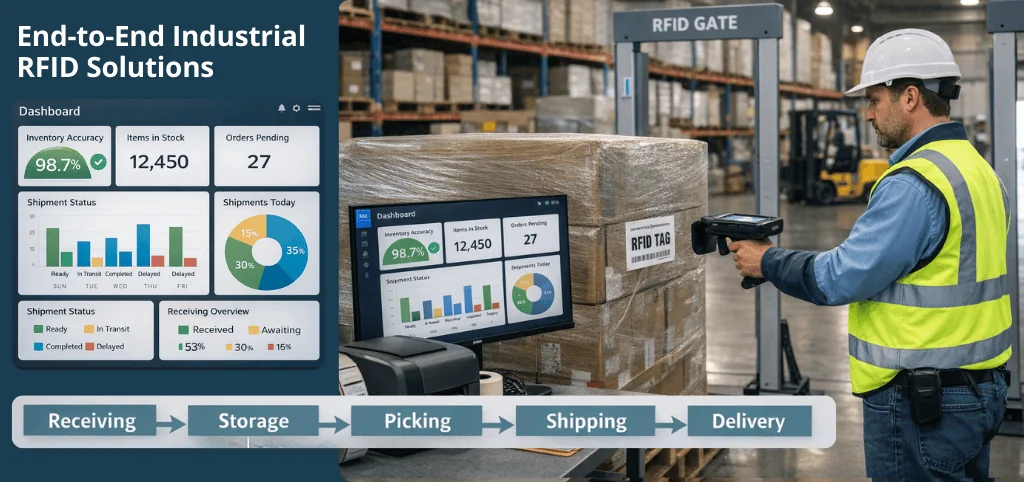
An end-to-end industrial RFID solution connects every stage of the product journey, from inbound receiving to outbound shipping. Instead of isolated hardware installations, it integrates UHF RFID tags, RFID readers, and centralised software into a unified ecosystem. This system captures real-time data automatically as assets move through warehouses, production lines, and distribution centres.
Without this integration, companies often struggle with inconsistent data between systems. Inventory inaccuracies lead to overstocking or stockouts. Manual cycle counts consume labour hours. Shipment errors increase return rates. These issues directly affect profitability and customer trust.
By implementing a connected RFID architecture, businesses move from reactive problem-solving to proactive supply chain management.
The Foundation: UHF RFID Tags
UHF RFID tags operate at ultra-high frequencies, allowing longer read distances and high-speed bulk scanning. Unlike barcodes, they do not require line-of-sight. This means entire pallets or containers can be scanned instantly as they pass through a reader gate.
For warehouse managers, this reduces bottlenecks at receiving and shipping docks. For production teams, it ensures accurate tracking of work-in-progress inventory. For executives, it provides confidence that inventory data reflects reality.
RFID Readers: Intelligent Data Capture Points
RFID readers serve as automated checkpoints throughout operations. Fixed readers at dock doors validate shipments. Conveyor-mounted readers monitor product flow. Handheld readers support flexible inventory audits.
When placed strategically, these readers create a continuous digital record of asset movement. However, hardware alone does not create business value. The real advantage comes when captured data is centralised, structured, and connected to enterprise systems.
From Hardware Deployment to Strategic Infrastructure
Many organisations begin with small RFID pilots. While helpful, isolated deployments rarely unlock full ROI. A true end-to-end industrial RFID solution integrates hardware with a centralised traceability platform.
This is where POXO plays a critical role. POXO transforms raw RFID data into actionable insights by centralising information across facilities. It connects with ERP, WMS, and MES systems, ensuring that data flows seamlessly into existing workflows.
The result is automated inventory updates, real-time shipment validation, and accurate reporting. More importantly, decision-makers gain a reliable foundation for forecasting, planning, and continuous improvement.
A Realistic Business Scenario
Consider a regional distributor managing thousands of daily shipments across multiple warehouses. Before RFID implementation, the company experienced regular shipment discrepancies and spent significant labor hours on manual cycle counts. Inventory accuracy hovered around 92 percent, which caused planning inefficiencies and customer complaints.
After implementing UHF RFID tags and fixed reader gates connected through POXO’s centralized platform, shipment validation became automatic. Inventory cycle counts were completed in a fraction of the previous time. Accuracy improved significantly, and management gained real-time visibility across all locations.
The operational improvements were measurable, but the strategic benefit was even greater. With reliable data, leadership could optimize stock levels, reduce safety buffers, and improve working capital efficiency.
Long-Term Strategic Value
Industrial RFID is not just about faster scanning. It enables automation, scalability, and traceability across the supply chain. As companies expand operations, open new facilities, or integrate automation technologies, a centralised RFID infrastructure ensures consistent data standards and visibility.
Traceability also strengthens compliance readiness. While regulatory environments continue to evolve, organisations with full digital asset histories are better prepared to adapt quickly. This future-ready foundation reduces operational risk and protects brand reputation.
By aligning RFID strategy with business goals, companies move beyond short-term efficiency gains and build long-term competitive advantage.
Why Now Is the Right Time
Rising labour costs, increasing SKU complexity, and growing customer expectations are pushing organisations to modernise operations. Manual processes cannot scale sustainably. The cost of inaction often exceeds the cost of transformation.
End-to-end industrial RFID solutions provide a practical path forward. They support automation initiatives, enable data-driven decision-making, and create operational resilience in uncertain markets.
Final Verdict: Turning Visibility Into Growth
Supply chain excellence requires more than isolated improvements. It demands real-time visibility, centralised data, and scalable infrastructure. End-to-end industrial RFID solutions powered by UHF RFID tags, RFID readers, and POXO’s traceability platform deliver exactly that.
For decision-makers, the opportunity is clear. Assess your current inventory accuracy, workflow efficiency, and traceability capabilities. Identify gaps that limit growth. Then explore how a structured RFID strategy can transform operations into a data-driven, future-ready supply chain.
The next step is simple: evaluate your readiness and connect with POXO to design an RFID solution aligned with your long-term business goals.
Frequently Asked Questions (FAQs)
**1. What is an end-to-end industrial RFID solution?
** An end-to-end industrial RFID solution connects UHF RFID tags, RFID readers, middleware, and a centralised software platform into one integrated system. It enables organisations to automatically track assets across warehouses, production lines, and distribution centres in real time. Rather than relying on isolated hardware deployments, it creates a unified infrastructure that delivers complete supply chain visibility.
**2. How do UHF RFID tags improve warehouse operations?
** UHF RFID tags enable bulk scanning without line-of-sight requirements. This allows pallets, cartons, and assets to be identified instantly as they pass through reader gates. The result is faster receiving, automated shipping validation, improved inventory accuracy, and reduced manual labour.
**3. What is the ROI of implementing industrial RFID?
** ROI depends on scale and operational complexity, but organisations typically see measurable improvements in inventory accuracy, labour efficiency, shipment validation, and stock optimisation. Long-term benefits include better forecasting, reduced operational risk, and stronger traceability across the supply chain.
**4. How scalable are RFID systems for growing businesses?
** Industrial RFID systems are highly scalable when designed correctly. With a centralised platform like POXO, companies can expand from a single facility to multiple locations while maintaining consistent data standards, automation workflows, and reporting structures.
**5. How long does it take to implement an RFID solution?
** Implementation timelines vary depending on operational size, integration requirements, and infrastructure readiness. Pilot deployments can take a few weeks, while full-scale enterprise rollout may require phased implementation over several months. Proper planning ensures minimal disruption and faster ROI realisation.