
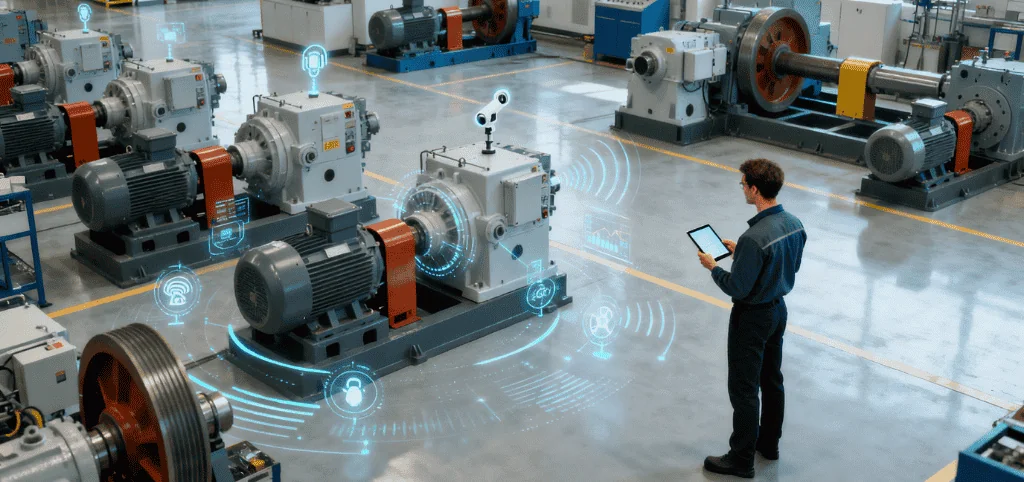
Unplanned downtime is one of the most expensive problems in any factory or warehouse. As industries become smarter and more connected, old methods of maintenance no longer work well. Predictive maintenance using AI, IoT sensors and RFID automation is now helping companies manage their plant assets in a much better way.
Shift From Reactive To Predictive Maintenance
For many years, companies used two basic methods. The first method was reactive maintenance, where a machine is repaired only after it breaks. The second method was preventive maintenance, where machines are serviced on fixed dates even if they do not actually need it.
Both methods waste time and money.
Today, predictive maintenance uses real-time data from sensors and RFID tags. It finds small issues before they turn into failures. This helps the maintenance team fix the machine at the right time. As a result, companies save money, reduce downtime and increase the working life of their assets.
How Predictive Maintenance Works
Predictive maintenance uses data from machines to understand their health and performance.
-
IoT sensors collect information like temperature, vibration, pressure and speed.
RFID tags help identify each asset and track its location and usage. -
Machine learning models study the data and detect unusual patterns that may cause a failure.
-
The system sends early alerts and also predicts how much useful life is left in a machine. With this information, the maintenance team can plan repairs before any breakdown happens.
Benefits For Industrial Operations
Reduced Downtime
Predictive maintenance can cut unplanned downtime by almost half. Repairs are planned during free hours, ensuring production continues to run smoothly.
Lower Maintenance Cost
Machines are serviced only when it is necessary. This reduces spending on spare parts labor, and urgent repairs.
Improve Safety And Asset Life
Continuous monitoring helps avoid accidents and increases machine life by a large margin. This is very important in industries like food manufacturing, pharma and power plants, where equipment failure can be risky.
Better Supply Chain Management
RFID-based tracking helps managers see the real-time condition of all equipment. This improves warehouse operations, spare parts planning, and overall supply chain flow.
Challenges In Adopting Predictive Maintenance
Older machines may need new sensors or digital connections. Maintenance teams also require training to effectively utilise dashboards and data. The good part is that the long-term savings are much higher than the initial investment.
POXO’s Role in Predictive Maintenance and RFID Automation
POXO specialises in connecting predictive maintenance with RFID automation, helping businesses capture real-time data and use it for smarter asset management. By using scalable solutions, businesses have the option to initiate operations with their most essential equipment and gradually cover other plants as their data maturity level and confidence increase. Such instruments give power to the mentioned sectors to make a shift in their maintenance type from reactive to proactive.
Our Solution Enables:
-
Real-time monitoring of plant assets
-
AI-driven alerts and early fault detection
-
RFID and sensor-based data collection
-
Proactive scheduling of repairs
-
Higher equipment reliability
-
Lean and efficient warehouse automation
The Future Of Industrial Maintenance
Industries are moving toward smarter and more connected systems. Predictive maintenance powered by AI, IoT, and RFID will soon become a common practice everywhere. Companies that take action now will enjoy safer operations, higher uptime, lower costs and stronger supply chains.
With the support of POXO, any business can build a modern and intelligent maintenance system that reduces downtime and improves asset performance.
RFID’s Specific Role in Predictive Maintenance
While IoT sensors collect condition data, RFID plays a distinct and critical role: asset identity and traceability. Sensors tell you what is happening — RFID tells you which machine it is happening to, when it was last serviced, and who performed that service.
Asset Identity at Every Touchpoint
Each piece of plant equipment carries an RFID tag — fixed readers or handheld terminals scan the tag when a technician approaches. This creates an automatic, time-stamped record that links every maintenance action to a specific asset. No more paper logs, no confusion between two identical machines in the same bay.
Maintenance History Stored on the Tag
RFID tags used for predictive maintenance programmes can store encoded data — asset ID, last service date, service type, and technician ID. Even without network connectivity at the machine location, a handheld reader can read this history on-site, giving the technician a complete picture before they begin work.
Spare Parts Traceability
Predictive maintenance also depends on the right spare part being available at the right time. RFID tagging of critical spare parts in the maintenance store allows real-time inventory of spares, automatic reorder triggering when stock drops below threshold, and a documented record of which part was installed in which machine — essential for warranty, audit, and failure analysis.
Practical Use Case: RFID Predictive Maintenance in an Automotive Plant
A Tier-1 automotive component supplier operating three production shifts faced an average of 4–6 unplanned machine stoppages per month. Each stoppage caused a line halt averaging 45 minutes — significant in a JIT (Just-in-Time) production environment where downstream assembly plants demanded hour-by-hour delivery.
The plant deployed:
- Vibration and temperature IoT sensors on 42 critical CNC machines and hydraulic presses
- RFID tags on all 42 assets and 280 key spare parts in the maintenance store
- POXO middleware connecting sensor data, RFID reads, and the CMMS (Computerised Maintenance Management System)
Results after 6 months:
- Unplanned stoppages dropped from 4–6 per month to 0–1 per month
- Planned maintenance windows were scheduled during off-peak hours using predictive alerts — average response time from alert to maintenance action fell from 4 hours to 40 minutes
- Spare parts inventory accuracy improved from 71% to 99.4% after RFID tagging of the maintenance store
- The plant’s OEE (Overall Equipment Effectiveness) increased by 8 percentage points
Implementing RFID-Enabled Predictive Maintenance: Step-by-Step
Phase 1 — Asset Survey and Tagging
Begin with a complete inventory of plant assets. Each asset receives an RFID tag with a unique EPC number that serves as its digital identity. This survey also identifies which assets are critical (failure causes production loss) versus routine (failure is inconvenient but manageable). Critical assets are prioritised for sensor deployment.
Phase 2 — Sensor Deployment and Connectivity
IoT sensors are installed on critical assets — typically vibration sensors on motors and rotating equipment, temperature sensors on electrical panels and furnaces, and pressure sensors on hydraulic and pneumatic systems. Sensors connect via industrial wireless protocols (Zigbee, LoRa, Wi-Fi) or wired Modbus/PROFIBUS where required.
Phase 3 — Data Integration
POXO’s middleware layer connects sensor streams, RFID reads from maintenance technician handhelds, and CMMS or ERP data. This integration creates a unified asset health view — each asset’s physical condition data, maintenance history, and operational context in one place.
Phase 4 — Baseline and Alert Configuration
The system collects baseline data for each asset under normal operating conditions. Thresholds are configured based on baseline — alerts trigger when readings deviate significantly. Machine learning models, where applied, refine thresholds based on operating patterns to reduce false positives.
Phase 5 — CMMS Workflow Integration
When an alert is triggered, the system automatically creates a work order in the CMMS, assigns it to a maintenance technician, and logs the triggering condition. The technician uses a handheld RFID reader to scan the asset on arrival, confirming their presence and starting the maintenance record. On completion, the work order is closed with parts used (from RFID-scanned spare parts) and action taken.
Phase 6 — Continuous Improvement
Monthly analysis of alert accuracy, response times, and maintenance outcomes allows the programme to improve over time. Alerts that consistently lead to findings are validated and thresholds tightened. Assets with strong maintenance records and no failures may have monitoring frequency reduced, freeing capacity for newer or more critical assets.
Frequently Asked Questions
Does predictive maintenance with RFID work for older machines without built-in sensors?
Yes. Retrofit IoT sensors can be added to most older machines regardless of manufacturer or vintage. Vibration, temperature, and current sensors attach externally to motor housings, panels, and pipework. RFID tags attach to any surface. The POXO system integrates these retrofit sensor readings with the same middleware used for newer equipment, so there is no separate system for old versus new assets.
How much does an RFID-based predictive maintenance system cost compared to the savings?
Total cost of deployment varies by the number of assets, connectivity infrastructure required, and ERP integration complexity. A typical deployment for a 50-asset production facility recovers its investment within 12–18 months through reduced unplanned downtime costs, lower emergency maintenance spend, and spare parts inventory optimisation. Plants with high OEE requirements (automotive, pharma, food) typically see payback in 6–12 months because the cost of a single unplanned stoppage is significant.
Can the system work without continuous network connectivity in the plant?
Yes. RFID handhelds operate offline — they store scans and maintenance records locally and sync to the central system when connectivity is available. Sensor gateways can also buffer data during network interruptions and upload when the link is restored. For critical assets in areas with unreliable connectivity, edge computing options allow local alert processing and barrier actuation without cloud dependency.
POXO’s Predictive Maintenance and RFID Asset Management Solution
POXO delivers end-to-end predictive maintenance programmes that combine RFID asset identity, IoT condition monitoring, and ERP integration into a single operational system. Our scope includes:
- RFID asset tagging — durable industrial tags for all environments including high-temperature, outdoor, and chemically aggressive conditions
- Handheld RFID terminals for technician-side maintenance confirmation and parts scanning
- IoT sensor deployment and connectivity — vibration, temperature, and pressure monitoring for critical assets
- POXO middleware — connecting sensor data, RFID reads, CMMS, and ERP in real time
- Dashboard and alerting — asset health overview, alert management, and maintenance KPI reporting
- Training and AMC support — operator training, ongoing system tuning, and 24/7 AMC support
We’ve deployed asset management and predictive maintenance programmes across automotive, pharmaceutical, food processing, and defence manufacturing clients across India.
If you’re ready to shift your plant from reactive firefighting to data-driven, predictive maintenance, contact POXO’s team to discuss your asset environment and get a scoped deployment plan.