
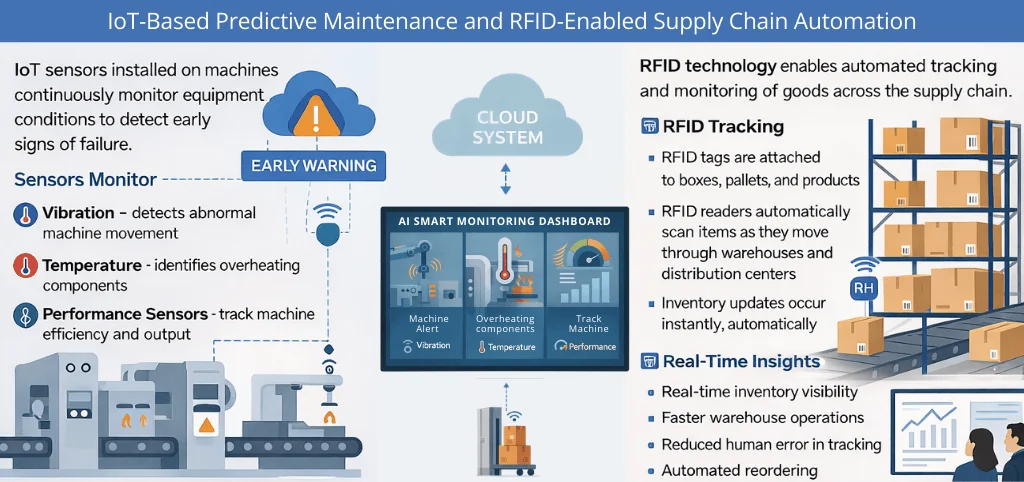
Operational failures rarely happen without warning. Motors vibrate differently before they fail. Inventory discrepancies appear long before they trigger stockouts. Environmental conditions drift outside acceptable ranges before damaging high-value goods.
Yet many facilities still operate reactively. They rely on barcode scans, periodic inspections, manual logs, and visual confirmation. By the time a problem becomes visible, throughput has already been disrupted.
In modern manufacturing and warehouse environments, this delay is no longer acceptable. Rising asset density, lean inventory strategies, and increasing customer expectations have transformed unplanned downtime from an inconvenience into a strategic risk.
This is why real-time data collection using RFID, IoT sensors, and predictive analytics is becoming foundational to intelligent facility management.
The Operational Cost of Reactive Manufacturing Environments
Most plants and warehouses experience more downtime than internal reports reflect. A conveyor motor overheats. A forklift battery underperforms. A returnable container goes missing. Each disruption adds friction. Sometimes it results in minutes of delay. Other times, it cascades into hours of lost output and missed delivery windows.
Manual processes amplify these vulnerabilities. Line-of-sight scanning leaves blind zones. Human-entered data introduces inconsistencies. Inventory counts drift from reality. Maintenance becomes time-based instead of condition-based.
Consider a pharmaceutical distribution facility operating temperature-controlled storage zones. If monitoring occurs only every few hours, a nighttime deviation can compromise thousands of dollars in product before anyone notices. With real-time IoT telemetry, the deviation triggers an alert instantly, preventing loss before damage occurs.
Reactive operations absorb losses. Intelligent operations prevent them.
How Real-Time Data Collection Transforms Facility Operations
A facility equipped with real-time RFID tracking and IoT monitoring does not wait for failure. It continuously interprets signals, including vibration patterns, temperature fluctuations, dwell times, unauthorised asset movement, and inventory variances. These signals become early indicators.
Instead of reacting to breakdowns, the system predicts them.
Instead of discovering missing assets, it identifies anomalies as they occur.
Instead of relying on periodic reporting, it creates continuous operational visibility.
This shift transforms the entire operating model.
Predictive Maintenance: Turning Equipment Data into Downtime Prevention
Predictive maintenance is one of the most immediate ROI drivers of real-time data collection in manufacturing.
Vibration and temperature sensors placed on motors, pumps, and compressors detect micro-changes in performance. Machine learning models analyse these signals and establish baseline patterns unique to each asset. When deviations occur, alerts are triggered days or even weeks before failure.
In automotive manufacturing plants, this prevents line stoppages during peak production cycles. In high-volume FMCG warehouses, it avoids conveyor downtime that could impact hundreds of outbound shipments in a single shift.
Instead of emergency repairs, maintenance becomes planned and strategic. Asset life extends. Spare parts inventory becomes more accurate. Labour shifts from reactive firefighting to preventive optimisation.
Real-Time RFID Asset Tracking and Inventory Visibility
Long-range UHF RFID readers eliminate blind spots across warehouses and production floors. With coverage extending up to 20 meters, assets can be tracked without manual scanning.
Custom RFID tags designed for industrial environments enable accurate tracking of material handling equipment fleets, returnable transport items, pallets and containers, high-value tools, and inbound and outbound loads.
This creates a continuous digital layer across operations. Inventory shrinkage decreases. Dock-to-stock times accelerate. Cycle counts reconcile faster. Compliance reporting improves. Managers make decisions based on real-time data rather than periodic estimates.
Overcoming Integration Challenges with Tailored Automation
One of the most common objections to implementing RFID and IoT systems is the complexity of integration. Legacy ERP systems, warehouse management platforms, and manufacturing execution systems often operate in silos.
Real-time automation must adapt to facility-specific conditions. RFID behaves differently in metal-heavy production environments compared to open warehouse aisles. Sensor placement must account for airflow, vibration patterns, and asset configuration. Predictive models require historical data unique to each operation.
Tailored automation solves this barrier. Rather than forcing facilities into rigid platforms, leading providers design hardware configurations, tag formats, and data capture workflows aligned with real operational behaviour. When RFID, IoT telemetry, and analytics function as a unified ecosystem, automation becomes scalable and sustainable. Integration becomes an advantage rather than a risk.
ROI and Strategic Value of Real-Time Data Infrastructure
The return on investment from real-time data collection compounds over time.
Unplanned downtime decreases as maintenance shifts to predictive models. Inventory discrepancies shrink due to continuous monitoring. Labour reallocates from scanning and searching toward higher-value tasks. Procurement decisions improve as real consumption patterns become visible.
Beyond cost reduction, real-time visibility builds resilience. Facilities scale without increasing chaos. Expansion does not require proportional increases in manual oversight. Decision-making accelerates because data latency disappears.
Industry analysts estimate that unplanned downtime costs manufacturers billions annually, while predictive maintenance strategies can reduce maintenance costs by up to 30 percent and eliminate a significant portion of unexpected failures.
Forward-looking organisations recognise that real-time data is not an optional enhancement. It is an operational infrastructure.
The Emerging Maturity Curve: From Monitoring to Autonomous Execution
Over the next three to five years, facilities will move beyond dashboards and alerts. Systems will begin executing automated decisions based on reliable real-time inputs.
Inventory may reroute automatically to prevent bottlenecks. Maintenance schedules may adjust dynamically based on live asset performance. Replacement parts may be reserved before technicians are even dispatched.
This next stage of intelligent manufacturing depends entirely on clean, continuous data streams. Without accurate RFID capture and trustworthy sensor inputs, automation becomes unreliable.
Organisations investing in real-time data collection today are building the foundation for autonomous operational systems tomorrow.
Conclusion: Real-Time Data Is the New Baseline for Intelligent Facilities
The shift from reactive to predictive operations is not simply a technology upgrade. It is a transformation in how facilities manage risk, capacity, cost, and resilience.
Real-time RFID tracking, IoT sensing, and predictive analytics enable organisations to prevent failures instead of reacting to them. They reduce waste, improve asset utilisation, increase labour efficiency, and unlock measurable ROI across supply chains.
For manufacturing leaders evaluating modernisation strategies, real-time data collection is no longer a future initiative.
Frequently Asked Questions (FAQs)
**1. How does real-time data reduce unplanned downtime?
** Real-time data monitors equipment conditions like vibration and temperature continuously. When anomalies are detected early, alerts allow maintenance teams to fix issues before they turn into breakdowns, preventing production stoppages.
******2. Are RFID systems reliable in metal-heavy industrial environments?
** Yes. Industrial-grade RFID tags and proper reader placement are designed to minimise interference from metal, ensuring reliable performance even in complex environments.
**3.****How long does it take for predictive maintenance models to become accurate
** Predictive models typically establish baseline patterns within a few weeks. Accuracy improves over time as more operational data is collected, with noticeable results often seen within a few months.
**4. Can real-time RFID and IoT systems integrate with existing ERP or WMS platforms?
** Yes. Modern systems use APIs and middleware to connect seamlessly with ERP, WMS, and MES platforms without disrupting existing workflows.
**5.****Is real-time data collection scalable across multiple facilities?
** Yes. Once a standardised system is implemented at one site, it can be replicated across multiple facilities efficiently, maintaining consistent visibility and control.