
Warehouse operations in India are changing rapidly. Growing SKU volumes, tighter delivery timelines, and higher compliance requirements are putting pressure on traditional tracking systems. Manual cycle counting and barcode-only scanning are no longer enough for high-growth environments.
This is why many operations leaders are now evaluating RFID pricing in India for 2026 budget planning.
However, the discussion often starts in the wrong place. Most businesses ask about the cost of tags or readers. In reality, RFID is not just a hardware purchase. It is a process transformation investment that improves accuracy, reduces labour dependency, and enhances operational predictability.
Understanding the true cost requires looking beyond components and examining the complete system.
Why RFID Pricing Should Be Measured Against Operational Loss
Many businesses hesitate because RFID appears expensive at first glance. But the hidden cost often exists inside current warehouse inefficiencies.
Inventory mismatches cause production delays. Manual cycle counts consume staff hours. Dispatch corrections increase operational friction. Audit seasons require additional manpower. Shrinkage quietly impacts margins month after month.
These losses rarely appear in a single cost line. Yet over a year, they can exceed the price of a well-implemented RFID system.
When evaluating RFID system cost in India, decision-makers must compare investment against recurring operational leakage. In many cases, even a one per cent reduction in shrinkage can significantly offset implementation expenses.
This is why pricing must be viewed strategically rather than transactionally.
What Determines RFID Pricing in India in 2026
RFID is not a single product. It is a combination of tags, readers, software, integration, and deployment planning. The final budget depends on scope, scale, and system complexity.
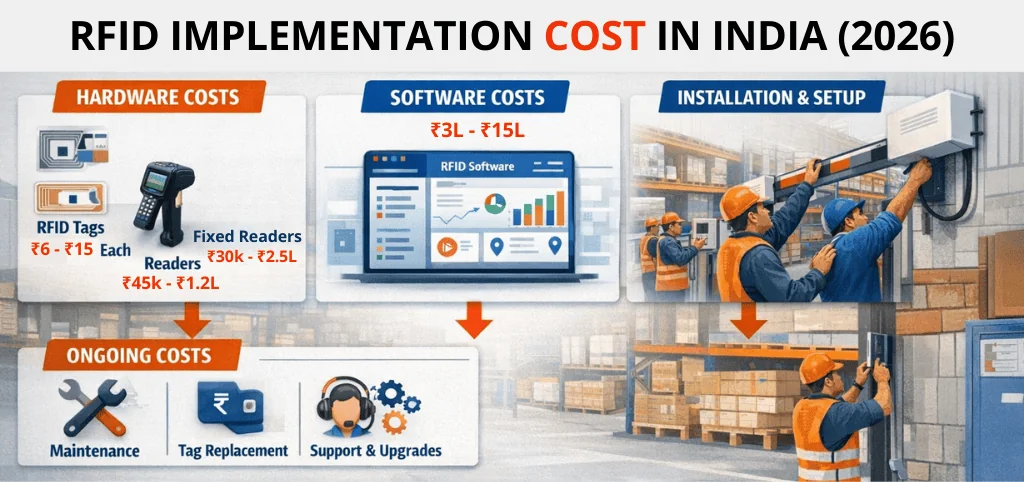
The first component is RFID tags. In India, passive UHF RFID tags typically range from ₹6 to ₹15 per unit for basic paper label versions. Metal-mount or specialised tags designed for harsh environments may range from ₹80 to ₹250 per piece. Pricing depends on tagging level, whether at item, carton, or pallet level, and on environmental durability requirements.
The second component is RFID readers. Handheld readers generally range from ₹45,000 to ₹1,20,000. Fixed readers, which are mounted at dock doors or key checkpoints, typically cost between ₹30,000 and ₹2,50,000. A full dock-door portal system, including antennas and mounting infrastructure, can range from**₹2.5 lakh to ₹8 lakh**. The number of read points required significantly influences the total system cost.
The third element is software and integration. RFID requires middleware to filter and process data before integrating with ERP or WMS platforms. Software costs in India generally range from ₹3 lakh to ₹15 lakh , depending on customisation depth, reporting dashboards, and analytics requirements. Integration complexity is often the most underestimated cost factor in RFID implementation.
The final component is implementation and deployment. This includes site surveys, RF testing, process mapping, configuration, and employee training. Deployment expenses typically range from ₹2 lakh to ₹10 lakh , depending on warehouse size and operational complexity. Proper planning at this stage determines long-term performance stability.
Total RFID System Cost for a Mid-Sized Warehouse
For a warehouse managing between 5,000 and 20,000 SKUs, the total investment in 2026 is typically estimated between ₹15 lakh and ₹60 lakh.
The wide range exists because every warehouse has different requirements. Larger facilities with multiple dock doors and higher transaction volumes will require more infrastructure. Businesses that demand real-time analytics and multi-location visibility will require more sophisticated integration.
When discussing the cost of RFID implementation in India, it is essential to define the project scope clearly before requesting vendor quotations.
Barcode vs RFID: Long-Term Cost Perspective
Barcode systems are widely adopted because they are simple and inexpensive to start. However, barcode scanning requires line-of-sight visibility and manual intervention for every transaction.
RFID eliminates line-of-sight requirements and allows bulk reading of multiple items simultaneously. This dramatically reduces counting time and improves accuracy.
Barcode systems typically achieve 80 to 90 percent accuracy in high-volume environments. RFID systems, when deployed correctly, achieve between 95 and 99 percent inventory accuracy.
Over a three to five-year period, many warehouses discover that RFID delivers a lower total cost of ownership due to reduced labour hours, fewer dispatch errors, and improved stock visibility.
The comparison should therefore focus on lifecycle cost rather than initial expense.
RFID ROI Timeline in Indian Warehouses
Most mid-sized warehouses in India recover RFID investment within twelve to twenty-four months. The speed of ROI depends on baseline inefficiencies and operational scale.
Labour reduction is often the largest savings contributor. Warehouses typically reduce manual cycle counting hours by thirty to fifty percent. Dispatch reconciliation errors may drop by sixty to eighty percent. A reduction of even 10 to 25 per cent in shrinkage can significantly impact annual margins.
Additionally, faster audit processes and improved compliance reporting add indirect value.
ROI improves further as warehouse scale increases, making RFID particularly attractive for growing organisations.
When RFID May Not Be the Right Investment
RFID is not universally required. Very small warehouses with limited SKU diversity and low transaction volumes may not justify the cost. Businesses with negligible shrinkage and minimal audit pressure may also see slower returns.
However, manufacturing units, FMCG distribution centres, pharmaceutical warehouses, automotive supply chains, and third-party logistics providers often experience strong ROI due to operational complexity.
Understanding fitment is critical before finalising budgets.
Strategic Budget Planning for 2026
Before allocating funds, operations leaders should conduct an internal cost analysis. Measuring current shrinkage rates, calculating monthly labour hours spent on counting, and evaluating dispatch error frequency can provide clarity.
A realistic three-year growth projection should also be considered. RFID systems are scalable, and early implementation may support future expansion without repeated infrastructure upgrades.
Budgeting for RFID should align with long-term operational strategy rather than short-term cost reduction.
Conclusion
Understanding RFID pricing in India requires evaluating the system as a long-term operational asset. While upfront investment may seem significant, the cost of ongoing inefficiency often exceeds implementation expense.
RFID enhances accuracy, reduces manual dependency, lowers shrinkage, and improves predictability across warehouse operations.
For leaders planning 2026 budgets, the critical question is not whether RFID costs more than barcode. The real question is whether existing inefficiencies are costing more than modernisation.
Frequently Asked Questions (FAQs)
**1. What is the average RFID pricing in India in 2026?
** For mid-sized warehouses, total project investment generally ranges between ₹15 lakh and ₹60 lakh, depending on scope and integration complexity.
**2. How long does it take to recover the RFID investment?
** Most warehouses achieve ROI within twelve to twenty-four months through labour savings and shrinkage reduction.
3. Are RFID tags expensive in India?
Basic RFID tags can cost as low as ₹6 per unit in bulk quantities, while specialised industrial tags cost more depending on durability needs.
4. Is RFID better than barcode for warehouse management?
RFID offers higher accuracy, faster counting, bulk reading capability, and improved real-time visibility, making it more scalable than barcode systems in high-volume operations.
**5. Which industries benefit most from RFID in India?
** Manufacturing, FMCG, pharmaceuticals, automotive, and logistics operations benefit most due to complex inventory movement and compliance requirements.