
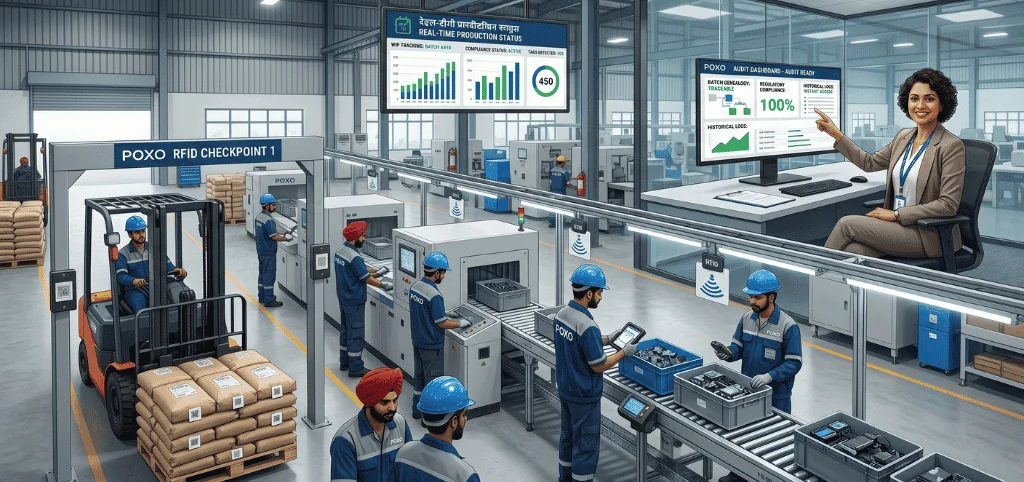
When an auditor asks for the complete history of a product, batch, component, or asset, the real test is not whether records exist it is how quickly and accurately the business can produce them.
Many manufacturers still rely on manual logs, spreadsheets, printed batch records, barcode scans, and supervisor sign-offs spread across production, quality, warehouse, and dispatch teams. While these methods may work during daily operations, they often create challenges during audits, quality investigations, customer complaints, or product recalls.
RFID traceability transforms this approach. Instead of reconstructing product history after the fact, manufacturers can automatically capture material movements, process events, asset usage, and finished goods status in real time.
The POXO RFID Traceability Solution enables manufacturers to build a centralised traceability layer across production and warehouse operations, improving visibility, compliance readiness, and operational control.
As manufacturers embrace Industry 4.0 initiatives, traceability has evolved from a compliance requirement into a strategic business capability. Real-time visibility into materials, assets, and production workflows enables organisations to reduce operational risks, improve supply chain transparency, and respond faster to quality incidents. RFID technology plays a critical role in helping manufacturers achieve digital transformation goals while strengthening regulatory compliance.
Key Takeaways
• RFID traceability reduces reliance on manual production and compliance records.
• Real-time visibility helps identify affected batches, lots, materials, and assets faster.
• Digital audit readiness is achieved by capturing evidence at the point of activity.
• Integration with ERP platforms such as SAP and ServiceNow makes traceability data operationally valuable across departments.
• RFID supports Industry 4.0 traceability, supply chain visibility, and smart manufacturing initiatives.
What Is RFID Traceability in Manufacturing?
RFID traceability in manufacturing is the process of using RFID tags, readers, and software platforms to automatically track raw materials, work-in-progress inventory, finished goods, assets, and product movements throughout the production lifecycle. This creates a real-time digital audit trail that improves compliance, product genealogy, quality control, and operational visibility.
Why Manual Traceability Breaks Down in Modern Manufacturing
Manufacturing teams rarely struggle with traceability because of negligence. More often, the challenge stems from increasingly complex production processes.
A single finished product may involve:
• Multiple raw material lots
• Semi-finished components
• Machines and operators
• Quality inspection points
• Storage locations
• Rework processes
• Dispatch movements
In industries such as automotive, electronics, pharmaceuticals, FMCG, and industrial manufacturing, even a minor data gap can delay investigations or expand the scope of a recall.
Manual tracking also introduces data latency. Materials may move through several production stages before records are updated, leaving supervisors and quality teams working with incomplete information.
Understanding Product Genealogy with RFID
Product genealogy refers to the complete historical record of a product, including raw materials, production processes, equipment used, operator interactions, quality inspections, storage movements, and shipment information.
RFID technology automatically captures these events throughout the manufacturing lifecycle, enabling organisations to quickly investigate quality issues, support compliance requirements, and improve customer confidence.
With RFID-enabled product genealogy tracking, manufacturers can trace every component and process involved in creating a finished product, significantly reducing investigation and recall times.
Why Point-of-Activity Data Matters
Modern audit readiness depends less on document storage and more on evidence generation.
Organisations that capture data at the moment activities occur do not need to prepare traceability records manually. Compliance evidence is generated automatically as operations take place.
This transforms traceability from a reporting requirement into a strategic operational capability.
By creating a real-time digital audit trail, manufacturers can strengthen compliance automation while improving operational transparency.
RFID Traceability Across Different Manufacturing Industries
**Automotive Manufacturing
** RFID helps automotive manufacturers track parts, assemblies, tools, and production workflows while supporting warranty investigations and supplier traceability requirements.
**Electronics Manufacturing
** Electronics manufacturers use RFID to monitor component genealogy, production status, and inventory accuracy across high-volume operations.
**Pharmaceutical Manufacturing
** RFID improves batch traceability, cold-chain visibility, serialisation support, and regulatory compliance throughout pharmaceutical supply chains.
**FMCG Manufacturing
** Consumer goods manufacturers benefit from faster inventory visibility, improved warehouse automation, and enhanced product recall management.
**Industrial Manufacturing
** Industrial manufacturers use RFID to track assets, raw materials, work-in-progress inventory, and finished goods while improving operational control and compliance. RFID asset tracking also helps organisations monitor equipment utilisation, reduce asset loss, and improve operational visibility across manufacturing facilities.
Real-World Scenario: Pharmaceutical Distributor Managing Multi-Batch Movements
Consider a pharmaceutical distributor handling temperature-sensitive products across receiving, storage, picking, packing, and dispatch operations. Without RFID, tracking batches often depends on barcode scans, paper records, and manual checks. If a quality issue occurs, teams must spend time finding where products were stored, shipped, or still available in inventory. This process can take hours. With RFID traceability, products can be tracked automatically in real time. Teams can quickly identify affected stock, shipped orders, and inventory on hold, helping them respond faster, reduce disruption, and improve recall accuracy.
Compliance Automation Starts with Reliable Operational Data
Compliance becomes challenging when production, quality, warehouse, and ERP data are stored in separate systems. This often creates gaps in visibility and makes it difficult to track product movements accurately. RFID helps solve this problem by automatically recording physical activities in real time. When connected with systems like SAP, ServiceNow, MES, WMS, and quality management platforms, RFID provides complete visibility into materials, batches, assets, and product movements. POXO brings all this information together in one place, helping manufacturers improve traceability, streamline audits, and make better operational decisions without replacing their existing systems.
Measuring RFID Traceability ROI
Beyond compliance benefits, RFID traceability often delivers measurable operational improvements.
• Manufacturers frequently experience:
• Reduced manual data entry
• Improved inventory accuracy
• Faster audit preparation
• Reduced investigation times
• Better warehouse efficiency
• Enhanced production tracking
• Improved supply chain visibility
Organisations evaluating RFID initiatives should establish baseline metrics for inventory accuracy, audit preparation effort, product recall response times, and operational visibility to measure business impact after implementation.
Business Benefits Beyond Audit Preparation
**Reduced Audit Preparation Time
** Digital traceability records eliminate the need to gather information from paper files, spreadsheets, and disconnected systems.
**Better Recall and Investigation Control
** Accurate batch histories help teams identify affected products quickly while reducing unnecessary recalls.
**Less Manual Paperwork
** Automated movement tracking minimises repetitive data entry and improves record accuracy.
**Improved Throughput and Dock-to-Stock Time
** RFID accelerates receiving and dispatch operations by reducing scanning bottlenecks.
**Scalable Visibility Across Multiple Sites
** Manufacturers can maintain consistent traceability standards across plants, warehouses, and distribution centres.
**Stronger Industry 4.0 Readiness
** RFID supports smart manufacturing initiatives by enabling real-time data collection, process automation, and operational intelligence.
What Manufacturers Should Evaluate Before Implementing RFID Traceability
Before deployment, organisations should answer the following questions:
• Which products, materials, batches, or assets require traceability?
• Where do traceability failures create the highest risk?
• Which process points require automated capture?
• What exceptions should trigger alerts?
• Which systems need RFID integration?
• How will RFID performance be validated under real operating conditions?
Most successful implementations begin with high-value areas such as:
• Receiving operations
• WIP tracking
• Quality hold zones
• Finished goods staging
• Dispatch verification
Next Steps
RFID traceability should be viewed as an operational readiness investment rather than merely a compliance initiative.
Manufacturers should begin by mapping their current product history process and identifying:
• Time-consuming manual activities
• Visibility gaps
• Compliance risks
• Areas where real-time data can improve decision-making
Ready to Improve Manufacturing Traceability?
Whether your organisation is struggling with audit preparation, product recalls, inventory visibility, or compliance reporting, RFID traceability can provide the real-time operational intelligence needed to reduce risk and improve efficiency.
POXO helps manufacturers evaluate traceability gaps, identify automation opportunities, and deploy RFID solutions that integrate seamlessly with SAP, ServiceNow, MES, WMS, and existing enterprise systems.
Schedule a consultation with POXO to assess your current traceability processes and build a roadmap toward real-time manufacturing visibility.
Frequently Asked Questions (FAQs)
**1. What is RFID traceability in manufacturing?
** RFID traceability uses RFID tags, readers, and software to automatically track materials, products, assets, and process movements throughout manufacturing operations.
**2. Is RFID better than barcode scanning?
**RFID is often superior for bulk reading, high-speed operations, and automated tracking, although many manufacturers use both technologies together.
**3. Which industries benefit most from RFID traceability?
** Industries including automotive, electronics, pharmaceuticals, FMCG, logistics, and industrial manufacturing benefit significantly from RFID traceability.
**4. How accurate is RFID traceability?
** RFID systems can achieve very high levels of accuracy when properly designed and deployed, significantly reducing errors associated with manual data entry and barcode scanning.
**5. How does RFID improve supply chain visibility?
** RFID provides real-time visibility into inventory, materials, shipments, and assets across warehouses, production facilities, and distribution networks.