
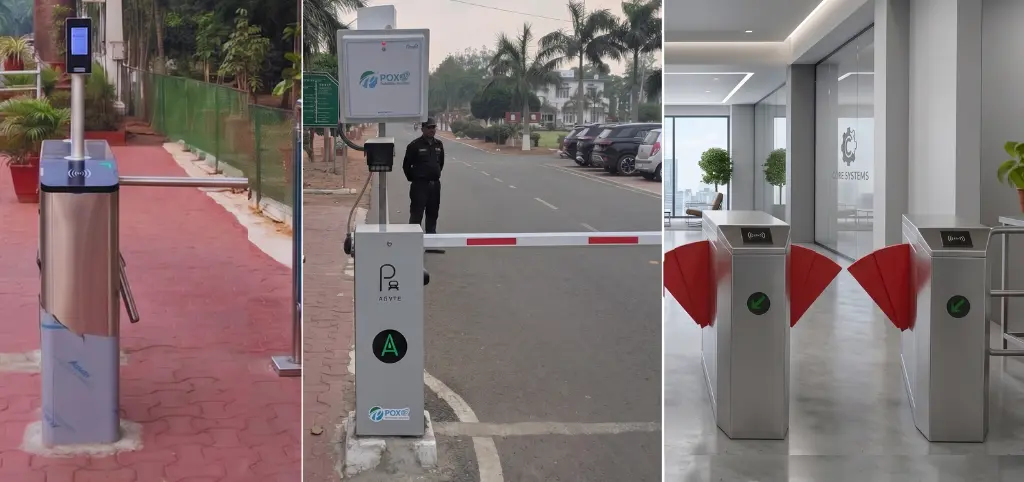
Every building, factory, or campus has one thing in common: an entrance. In today’s fast-paced industrial environment, securing that entrance is the first step toward operational excellence. It is the primary point of contact for employees, visitors, and vehicles, and it is also the most vulnerable point for security breaches. Manual security guards, paper registers, and physical keys are no longer sufficient to manage the speed and volume of daily traffic.
This is where POXO’s entrance automation solutions come in. Our systems integrate advanced RFID and sensor-driven technology to control, monitor, and manage traffic flow without compromising speed or safety. Think of it as a digital security guard that never sleeps, maintains perfect audit trails, and ensures only authorized personnel enter your premises.
In this blog, we’ll break down the three core pillars of entrance automation: Tripod Turnstiles with Face Recognition, Flap Barriers, and Boom Barrier-based Vehicle Management Systems. We will explore how these solutions can transform your facility’s security and drive long-term efficiency.
What Is an Entrance Automation System?
In simple terms, an entrance automation system is a combination of hardware (gates, barriers, sensors, cameras) and software (RFID readers, controllers, recognition systems) that automatically verifies and allows or denies entry to people or vehicles, without requiring a person to physically check each individual. At its core, it functions as a complete RFID access control solution managing who gets in, when, and through which entry point.
Think of it as a digital security guard that never gets tired, never makes exceptions for “VIPs” without authorization, and keeps a perfect record of every entry and exit.
These systems are typically used for:
- Pedestrian access control (employees, visitors, students)
- Vehicle access and parking management
- Time and attendance tracking
- Restricted area protection
- Visitor management and audit trails
1. Tripod Turnstile with Face Recognition: Smart Pedestrian Access Control
A tripod turnstile is one of the most recognisable access control devices. You’ve probably seen one at a metro station, office lobby, or factory gate. It looks like a small pedestal with rotating arms that open only when authorized access is granted.
How It Works
The Tripod Turnstile TWL Face Recognition system combines a traditional tripod barrier mechanism with a facial recognition terminal over the top. Here’s the flow:
- A person walks up to the turnstile.
- The face recognition camera scans and matches their face against a pre-registered database (or accepts an RFID card or QR code as backup).
- If verified, the arms rotate to allow entry. If not, they stay locked, and the system logs the rejected attempt.
- The system automatically records the person’s entry time, which is sent to the time and attendance software. No separate biometric punch-in needed.
Key Features
- Anti-tailgating Design: Only one person passes per verification cycle. The arms lock immediately after one pass, preventing a second person from slipping through.
- Dual Authentication Options: Face recognition as primary, with RFID card or QR as fallback. Useful for scenarios where face recognition may struggle, such as wearing full PPE in industrial environments.
- Bi-directional Flow: The same turnstile can manage both entry and exit, recording timestamps in both directions.
- Attendance Integration: Because the turnstile is also the attendance punch point, there’s no need for a separate biometric device. One device handles both security and HR requirements.
Where It’s Used
- Factories and manufacturing plants with shift-based workforces
- Government buildings and defence establishments
- Schools, colleges, and universities
- Metro stations and public transit points
- Warehouses and logistics hubs
2. Flap Barrier Turnstile: High-Speed, Premium Pedestrian Control
While the tripod turnstile works well for standard-duty environments, the flap barrier is its sleeker, faster cousin, designed for locations where aesthetics, speed, and high footfall matter.
A flap barrier uses retractable glass or acrylic panels (flaps) that slide open when authorized access is verified and snap shut immediately after. It looks more like something you’d see in a premium office lobby or airport rather than a factory gate.
How It Works
- A person approaches the flap barrier lane.
- The system verifies their identity through face recognition, RFID card, QR code, or biometric input.
- The flaps retract instantly (typically in under 0.5 seconds), allowing passage.
- The flaps close immediately after the person passes, preventing any unauthorized follower from entering.
Key Advantages over Tripod Turnstiles
- Speed: Flap barriers open and close much faster, making them ideal for high-traffic environments where hundreds of people need to pass within minutes.
- Aesthetics: The glass panels and slim design give a premium, modern look suitable for corporate and public spaces.
- Wheelchair and ADA Accessibility: Wider lane flap barriers can accommodate wheelchairs and trolleys, which tripod turnstiles cannot.
- Safety: The flap edges are typically equipped with sensors to prevent closing on a person mid-passage.
Where It’s Used
- Corporate headquarters and premium office lobbies
- Airports and metro stations
- Banks and financial institutions
- Hospitals, for staff-only zones
- Manufacturing plants with high employee turnover during shift changes
3. Boom Barrier Based Vehicle Management System: Complete Parking and Entry Automation
While turnstiles and flap barriers manage people, vehicle entry needs a different, more robust solution, and that’s where the boom barrier comes in.
A boom barrier (also called a boom gate) is the long arm-like barrier you see at toll booths, parking lots, and gated communities. But on its own, a boom barrier is just a gate. The real power comes when it’s combined into a full vehicle management system.
The Complete Boom Barrier Solution
A truly automated vehicle management system isn’t just a barrier arm. It’s an integrated ecosystem of devices working together:
Boom Barrier with Photo Cell Sensor
The photo cell (infrared) sensor acts as a safety device. It detects if a vehicle or person is under the barrier arm while it’s closing, and immediately reverses the arm to prevent accidents or damage. This is a non-negotiable safety feature for any boom barrier installation.
Two-Way Push Button
For locations needing manual override, or for security personnel to control entry and exit manually (such as during system maintenance or for unregistered visitor vehicles), a two-way push button allows easy manual operation from both sides.
ANPR Camera (Automatic Number Plate Recognition)
This is where things get really smart. The ANPR camera automatically reads and captures a vehicle’s number plate as it approaches. This data can be:
- Cross-checked against an authorized vehicle database
- Used for automatic billing in paid parking facilities
- Stored for security audits and incident investigation
- Used to flag blacklisted or unauthorized vehicles instantly
UHF High Performance RFID Reader (with Controller) and UHF Windshield Tags
For registered vehicles, such as employee cars, resident vehicles, or fleet vehicles, a UHF (Ultra High Frequency) RFID tag is fixed on the windshield. As the vehicle approaches the gate:
- The UHF reader detects the tag from a distance, typically 3 to 8 meters, even at moving speed
- The controller validates the tag against the authorized database
- The boom barrier opens automatically, with no need for the driver to stop, roll down the window, or show any ID
This is what makes long-range, hands-free vehicle entry possible, and it’s perfect for factories, corporate campuses, and gated townships where hundreds of vehicles enter daily.
Biometric Time and Attendance Integration
For employee vehicles, the same UHF tag-based entry can be linked to time and attendance systems, meaning the moment an employee’s car enters the gate, their attendance can be automatically marked. This eliminates the need for separate biometric punch-ins at a different location.
Device Mounting Stand and Installation
All hardware, including the ANPR camera, UHF reader, controller box, and sensors, must be mounted on weatherproof stands near the boom barrier to ensure accurate detection and long-term durability. Professional installation ensures correct reader angles, camera positioning, and sensor calibration for maximum accuracy.
Why a Complete Boom Barrier System Beats a Standalone Barrier
A standalone boom barrier only does one thing: open and close. But a complete system like POXO’s solution:
- Identifies vehicles automatically through ANPR and UHF
- Prevents accidents with photo cell sensors
- Allows manual control when needed through push buttons
- Tracks attendance through biometric integration
- Creates a digital log of every vehicle movement, useful for security, compliance, and operational analytics
Where It’s Used
- Factory and industrial gates
- Corporate and IT parks
- Gated residential communities and townships
- Paid parking facilities such as malls, hospitals, and airports
- Toll plazas and logistics hubs
Real-World Proof: POXO’s Installation at a Ministry of Defence Campus, Odisha
The scenario above isn’t hypothetical. POXO deployed exactly this kind of integrated system at a Ministry of Defence (MOD) establishment in Ganjam, Odisha, one of the most security-critical environments possible.
The installation combined UHF RFID readers, ANPR cameras, and a boom barrier for vehicle access, alongside tripod turnstiles with face recognition for pedestrian entry, all running on a single software platform. Authorised vehicles were identified hands-free via windshield RFID tags; staff walked through turnstiles using face recognition that simultaneously logged their attendance; and the security team had complete visibility over both vehicle and foot traffic from one dashboard.
Read the full case study: RFID Vehicle & Visitor Access Control System (MOD) Odisha
Key Benefits of Entrance Automation Systems
- Enhanced Security: Every entry and exit is verified and recorded. No more situations where someone says, “I forgot my ID, let me in” and compromises security.
- Reduced Manual Dependency: Fewer security personnel are needed at each gate, and those present can focus on exceptions and monitoring rather than routine checks.
- Faster Throughput: RFID, UHF, and face recognition are all faster than manual ID checking, which is critical during peak entry and exit hours like shift changes.
- Accurate Attendance and Audit Trails: Integration with time and attendance systems removes manual punch-ins and gives HR teams accurate, tamper-proof data.
- Cost Savings Over Time: While there’s an upfront investment, reduced manpower costs, fewer security incidents, and better operational data lead to long-term savings.
- Scalability: These systems can be expanded by adding more turnstiles, barriers, or readers as the organization grows, without overhauling the entire setup.
Choosing the Right Entrance Automation System for Your Needs
Here’s a simple way to think about it:
- High security, single-person verification needed? Choose a Tripod Turnstile with Face Recognition.
- High footfall, premium look, fast pedestrian flow? Choose a Flap Barrier Turnstile.
- Vehicle entry, exit, parking management, or fleet tracking? Choose a Complete Boom Barrier System with ANPR and UHF.
For most medium to large facilities, such as factories, campuses, and gated communities, a combination of all three delivers the most complete security and management solution.
Conclusion
As facilities grow and security expectations rise, manual entry management simply can’t keep pace. Entrance automation systems, whether a face recognition turnstile, a high-speed flap barrier, or a fully integrated boom barrier system with ANPR and UHF RFID, give organizations the tools to manage access efficiently, safely, and intelligently.
At POXO, we design and deploy complete entrance automation solutions customized to your facility’s needs, from pedestrian turnstiles to full vehicle management systems with photo cell sensors, ANPR cameras, UHF readers, and biometric attendance integration.
If you’re looking to upgrade your facility’s entry points with smart, automated, and secure access control, get in touch with our team for a site assessment and customized solution.