
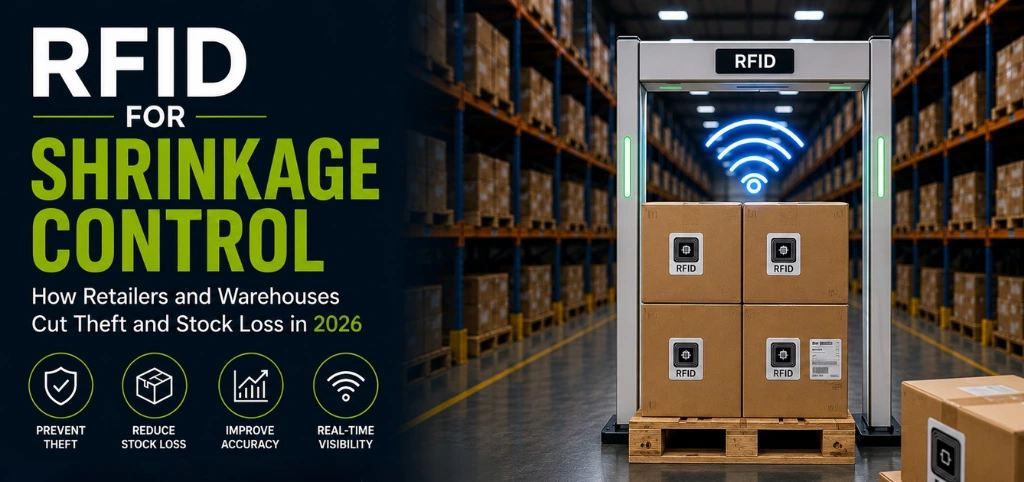
Inventory shrinkage rarely appears as one large event. It usually builds through small losses: an item removed without authorisation, a carton misplaced after receiving, a picking error that goes unnoticed, or stock that exists in the system but cannot be found on the floor.
For retailers, e-commerce fulfilment centres, and warehouse operators, these gaps create more than inventory discrepancies. They reduce margins, distort demand planning, delay replenishment, and weaken customer trust. A product that cannot be located is often treated the same as a product that was never available.
RFID technology changes this operating model. By improving RFID inventory accuracy and enabling real-time visibility, businesses can reduce RFID shrinkage across stores, warehouses, and distribution centres. By using RFID tags, fixed or handheld readers, and centralised software, businesses can track inventory movement in real time across stores, stockrooms, warehouses, docks, and distribution points. Instead of discovering losses during month-end reconciliation, operations teams can identify exceptions as they happen.
The result is a more preventive approach to loss control: fewer unknown losses, faster cycle counts, better inventory accuracy, and stronger accountability across locations.
Key Takeaways
• RFID helps retailers and warehouses detect unauthorised inventory movement before losses become difficult to investigate.
• Real-time item visibility reduces dependence on manual counts and improves inventory accuracy, often above 95–99% in well-managed deployments.
• Shrinkage control improves when RFID data is linked to operational workflows such as receiving, picking, transfers, dispatch, and returns.
• The strongest ROI comes from treating RFID as an inventory intelligence system, not only as a tagging technology.
Why Traditional Shrinkage Control Falls Short
Most inventory control systems depend on periodic checks. Stock is received, recorded, moved, sold, transferred, or picked, and then verified later through audits or cycle counts. The problem is the time gap between movement and verification.
If a high-value item disappears from a store stockroom on Monday but the discrepancy is found during a weekend count, the investigation window is already too wide. Multiple employees, customers, transfers, and system transactions may have touched the item by then.
Manual counting also introduces error. In busy warehouses and retail backrooms, teams handle mixed SKUs, similar packaging, partial cartons, returns, and damaged goods. Even disciplined operations can face mismatches between physical stock and system stock.
For multi-location retailers and distribution networks, the challenge becomes more complex. Inventory may move between stores, dark stores, warehouses, and customer return points. Without item-level visibility, loss prevention teams often know what is missing but not where, when, or why it went missing.
These visibility gaps are one reason many organisations are adopting RFID for retail shrinkage reduction and operational loss prevention.
How RFID Creates Real-Time Inventory Visibility
RFID works by attaching a tag to an item, carton, pallet, asset, or container. RFID readers capture tag data without requiring direct line-of-sight scanning. The software layer then converts these reads into movement events, location updates, alerts, and inventory records.
In a retail or warehouse environment, RFID can be used at several control points:
• Receiving docks to confirm inbound stock
• Store entrances and exits to detect unauthorised movement
• Stockrooms to locate misplaced items
• Picking zones to validate order accuracy
• Dispatch areas to verify outbound shipments
• Return counters to reconcile returned products
• High-value storage areas to monitor restricted movement
This creates a continuous inventory trail. The same visibility also strengthens RFID theft prevention efforts by helping teams detect unauthorised inventory movement sooner.
Instead of asking teams to confirm what should be present manually, RFID allows systems to verify what is actually present at a given location.
The practical value extends beyond faster counting to faster exception handling.
From Inventory Counting to Inventory Event Control
A common mistake is to view RFID as a faster barcode system. That underestimates its role in shrinkage control.
Barcodes confirm transactions when someone scans an item. RFID can detect movement even when no one initiates a scan. This matters because shrinkage often occurs outside the intended workflow.
For example, if a tagged product leaves a storage area without a transfer order, the system can flag it as an exception. If cartons arrive at a dock but do not appear in the put-away zone, the gap can be investigated immediately. If a high-value SKU is repeatedly moved between zones before dispatch, the pattern may indicate process leakage or potential misuse.
For organisations dealing with recurring inventory losses, RFID theft prevention strategies provide a proactive way to identify unauthorised inventory movement before shrinkage impacts profitability.
This is the shift from audit-based loss prevention to flow-based loss prevention. Mature operations are no longer waiting for reconciliation reports. They are monitoring inventory behaviour.
Practical Scenario: RFID in an FMCG Warehouse
Consider an FMCG distribution warehouse handling fast-moving personal care products across multiple retail outlets. In high-volume operations, RFID warehouse theft and inventory discrepancies can be difficult to identify through periodic audits alone. The warehouse processes high order volumes, short dispatch windows, and frequent SKU changes.
Shrinkage is hard to isolate because missing stock may be caused by theft, picking errors, incorrect put-away, short receiving, or dispatch mismatch.
By tagging cartons and installing RFID readers at receiving, storage aisles, picking consolidation areas, and exit gates, the warehouse can build a real-time movement trail.
When inbound cartons enter the dock, RFID validates receipt against the purchase order. During put-away, the system confirms whether stock reaches the assigned zone. At picking, items are matched against the order. At dispatch, an exit read confirms that only authorised cartons leave the facility.
If a carton appears at the exit gate without a valid dispatch record, the system raises an alert. If a carton is received but never moves into storage, the team can investigate the receiving area before the next shift begins. If cycle counts show recurring discrepancies in one zone, managers can review process discipline, layout, access control, and staff accountability.
This approach reduces stock loss, but it also improves throughput. Teams spend less time searching for missing goods and more time executing planned work.
Business Benefits of RFID-Based Shrinkage Control
**Higher Inventory Accuracy
** RFID inventory accuracy is one of the most valuable outcomes of a well-designed deployment. Accurate inventory data supports better replenishment, allocation, and order fulfilment decisions. RFID-enabled operations often achieve accuracy levels above 95–99% when tagging strategy, read points, and process controls are properly designed.
For retailers, this means fewer “available online but missing in store” situations. For warehouses, it reduces order holds, emergency recounts, and avoidable reshipments.
**Faster Cycle Counts and Stock Audits
** RFID reduces the labour intensity of physical counts. Teams can scan shelves, racks, bins, or floor areas much faster than manual barcode counting.
This enables more frequent cycle counts without disrupting operations. Instead of waiting for quarterly or annual audits, inventory control teams can validate high-risk SKUs weekly or even daily.
**RFID Theft Prevention and Unauthorised Movement
** RFID theft prevention capabilities help businesses detect unauthorised item movement quickly through automated alerts, exit reads, and real-time inventory visibility. This does not replace physical security, access control, or loss prevention procedures, but it strengthens them with data.
The key advantage is speed. Earlier detection improves the chance of recovery and reduces the investigation burden.
For retailers dealing with frequent stock discrepancies, RFID for retail shrinkage reduction provides an additional layer of visibility that helps identify exceptions before they become significant losses.
**Better Accountability Across Locations
** In multi-store and multi-warehouse networks, RFID creates a consistent visibility layer. Each item movement can be linked to a location, process stage, and timestamp.
This gives operations leaders a clearer view of where shrinkage originates—whether in receiving, storage, picking, transfers, returns, or dispatch.
Accountability becomes process-based rather than assumption-based.
**Lower Operational Costs
** Manual inventory reconciliation consumes time from warehouse teams, store staff, supervisors, and finance teams. RFID reduces the rework caused by mismatched stock records, missing items, and slow investigations.
The ROI is strongest where shrinkage, labour cost, high SKU volume, or customer service impact is significant.
What to Evaluate Before Implementing RFID
RFID success depends on process fit. A tag-and-reader deployment without workflow alignment will not deliver full value.
Operations teams should assess:
• Which SKUs or categories contribute most to shrinkage
• Where inventory visibility breaks down most often
• Whether item-level, carton-level, or pallet-level tagging is required
• Which read points will generate meaningful control events
• How alerts will be handled by store, warehouse, or loss prevention teams
• Whether RFID data can integrate with ERP, WMS, POS, or inventory systems
• How cycle counts and inventory reconciliation will change after implementation
This readiness work prevents over-engineering. Not every asset needs item-level tracking. In some environments, carton-level RFID at key movement points delivers measurable gains with lower implementation complexity.
Organizations should also evaluate how RFID data will support broader inventory management objectives, including RFID inventory accuracy improvements, compliance requirements, and operational reporting.
The Forward-Looking Shift: Shrinkage Analytics, Not Just Shrinkage Detection
Beyond reducing RFID shrinkage, movement analytics can reveal patterns that contribute to recurring inventory losses.
The next stage of RFID-based loss prevention is not only detecting missing stock. It is using movement data to predict where shrinkage is likely to occur.
As RFID systems collect more data, businesses can identify recurring exception patterns:
• Specific zones with frequent mismatches
• SKUs with unusual movement paths
• Shifts with higher manual overrides
• Transfer routes with repeated discrepancies
This is a non-obvious advantage. RFID creates an operational behaviour map. Over time, that map can reveal process weaknesses before they become financial losses.
For experienced operations leaders, this is where RFID becomes strategic. It supports better layout decisions, staffing controls, process redesign, supplier accountability, and compliance readiness.
Loss prevention moves from reactive investigation to preventive operating discipline.
One additional strategic benefit is that RFID data can help organizations identify the root causes of inventory loss, whether they stem from process failures, receiving discrepancies, operational inefficiencies, or potential RFID warehouse theft incidents. This deeper level of visibility allows businesses to focus resources on prevention rather than investigation.
Where POXO Fits in RFID Shrinkage Control
POXO enables retailers, warehouses, and supply chain operators to build RFID-based visibility systems that connect physical inventory movement with centralized data.
The focus is not only on installing RFID tags and readers. These capabilities help improve RFID inventory accuracy, strengthen RFID theft prevention, and support long-term inventory control initiatives. It is also about designing traceability workflows, automation logic, dashboards, alerts, and integration points that support real operations.
For a retail chain, this may mean store-level stock visibility, faster cycle counts, and unauthorized movement alerts. For a warehouse, it may mean dock-to-stock tracking, dispatch validation, and inventory reconciliation across zones. For growing networks, it means creating a scalable foundation that can support compliance readiness, asset tracking, and future automation.
Organizations implementing RFID often face challenges not with the technology itself, but with workflow integration, user adoption, and exception management. Effective RFID deployments require clearly defined business processes, accurate read-point design, and seamless integration with inventory management systems.
RFID works best when it becomes part of daily execution, not a separate technology layer.
Next Steps
Inventory shrinkage is no longer just a reporting issue it is a visibility issue. Organizations that can monitor inventory movement in real time are better positioned to prevent losses, improve inventory accuracy, and strengthen operational accountability.
RFID gives retailers and warehouse operators the ability to track stock movement in real time, detect exceptions earlier, and improve inventory accuracy without adding more manual work.
The practical next step is to assess where visibility gaps exist today. Review high-shrink SKUs, failed cycle counts, dock-to-stock delays, transfer mismatches, and unauthorized movements. Then evaluate where RFID can create the strongest control point with the shortest path to measurable ROI.
For teams exploring RFID-based shrinkage control, the right starting point is not a full-scale rollout. It is a focused readiness assessment that identifies inventory loss patterns, process gaps, and automation opportunities across the operation.
By starting with a targeted pilot and measurable objectives, organizations can validate the business value of RFID before expanding deployment across stores, warehouses, and distribution networks.
Frequently Asked Questions (FAQs)
1. How does RFID help reduce inventory shrinkage?
RFID reduces RFID shrinkage by tracking inventory movement in real time and identifying unauthorized movement, misplaced inventory, receiving gaps, dispatch mismatches, and process exceptions before they become significant losses. Instead of discovering discrepancies during periodic audits, businesses can investigate and address issues as they occur.
2. Is RFID better than barcode scanning for loss prevention?
RFID and barcodes serve different purposes. Barcodes require direct scanning and line-of-sight visibility, while RFID can capture multiple tagged items automatically without manual intervention. For shrinkage control, RFID is often more effective because it can detect inventory movement events even when employees do not actively scan items.
3. Can RFID prevent employee theft and shoplifting?
RFID supports RFID theft prevention by providing real-time visibility into inventory movement and generating alerts when unauthorized movement occurs. While RFID should be combined with physical security measures, access controls, and operational procedures, it significantly improves detection speed and accountability.
4. What inventory accuracy can businesses achieve with RFID?
Well-designed RFID deployments frequently achieve inventory accuracy levels above 95–99%. Results depend on factors such as tagging quality, reader placement, system integration, staff adoption, and process discipline. Improved RFID inventory accuracy helps reduce stock discrepancies, replenishment errors, and fulfillment delays.
5. What is the best starting point for RFID implementation?
The most effective starting point is a visibility gap assessment. Organizations should identify where inventory losses occur most frequently, which SKUs are most affected, and which operational processes require better monitoring. A focused pilot targeting high-shrink categories, RFID warehouse theft risks, or critical warehouse zones is often the fastest path to measurable results.